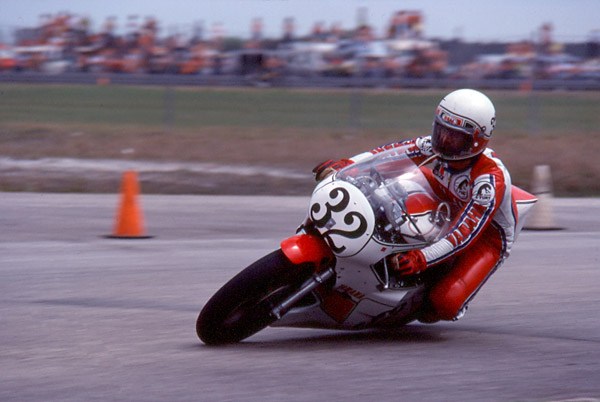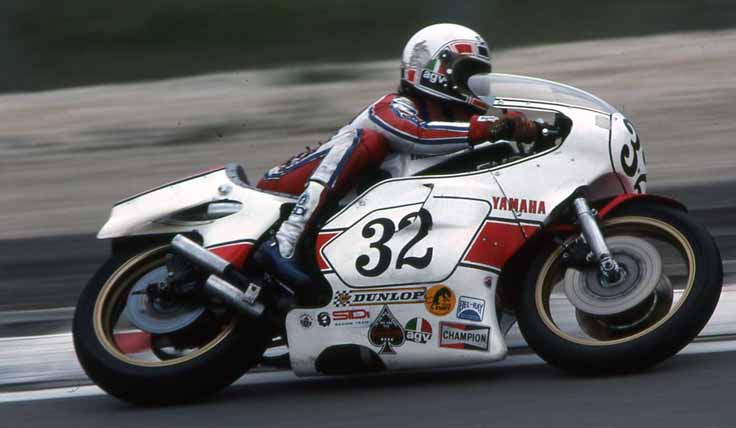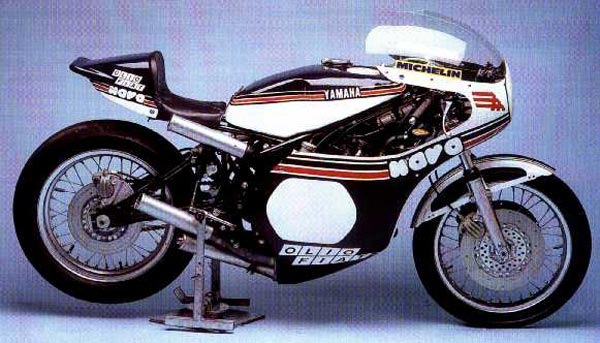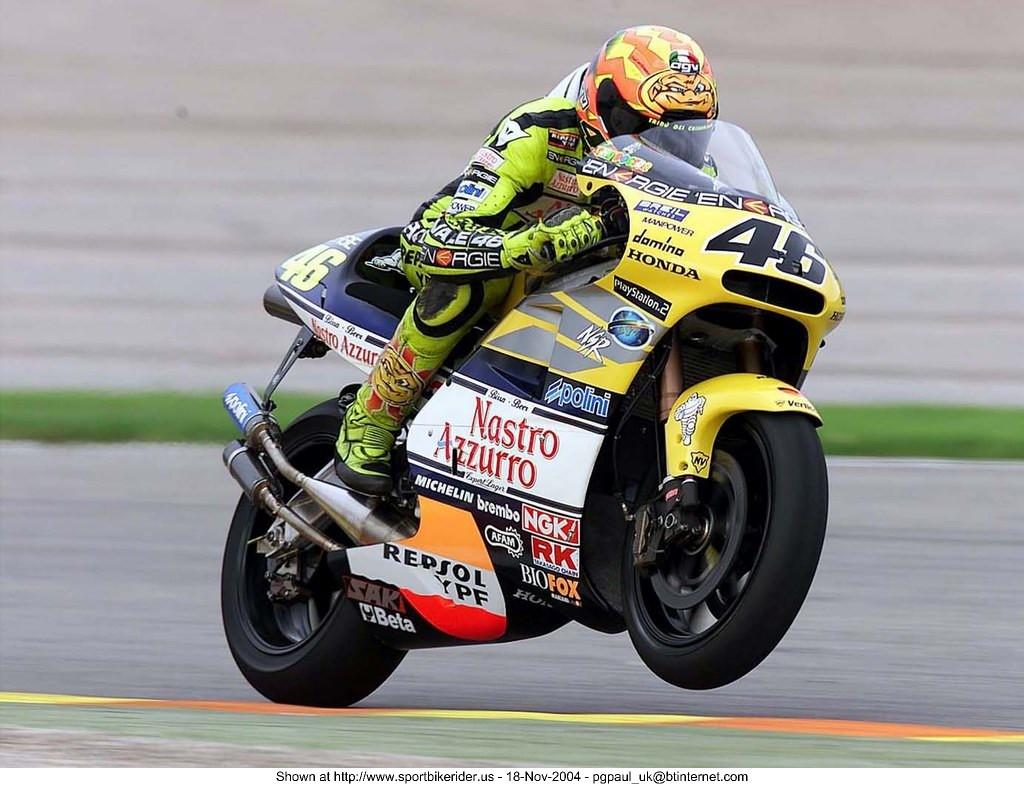
Superhuman

In a recent interview with U.K. newspaper The Telegraph, the most successful design engineer in F1 history made quite a thought-provoking statement. Adrian Newey commented, “If you watch a sport – it doesn’t matter what sport – you want to come away with a feeling those guys are special. If you watch MotoGP, you think those guys are just superhuman. You just don’t get that with the current breed of F1 cars.”

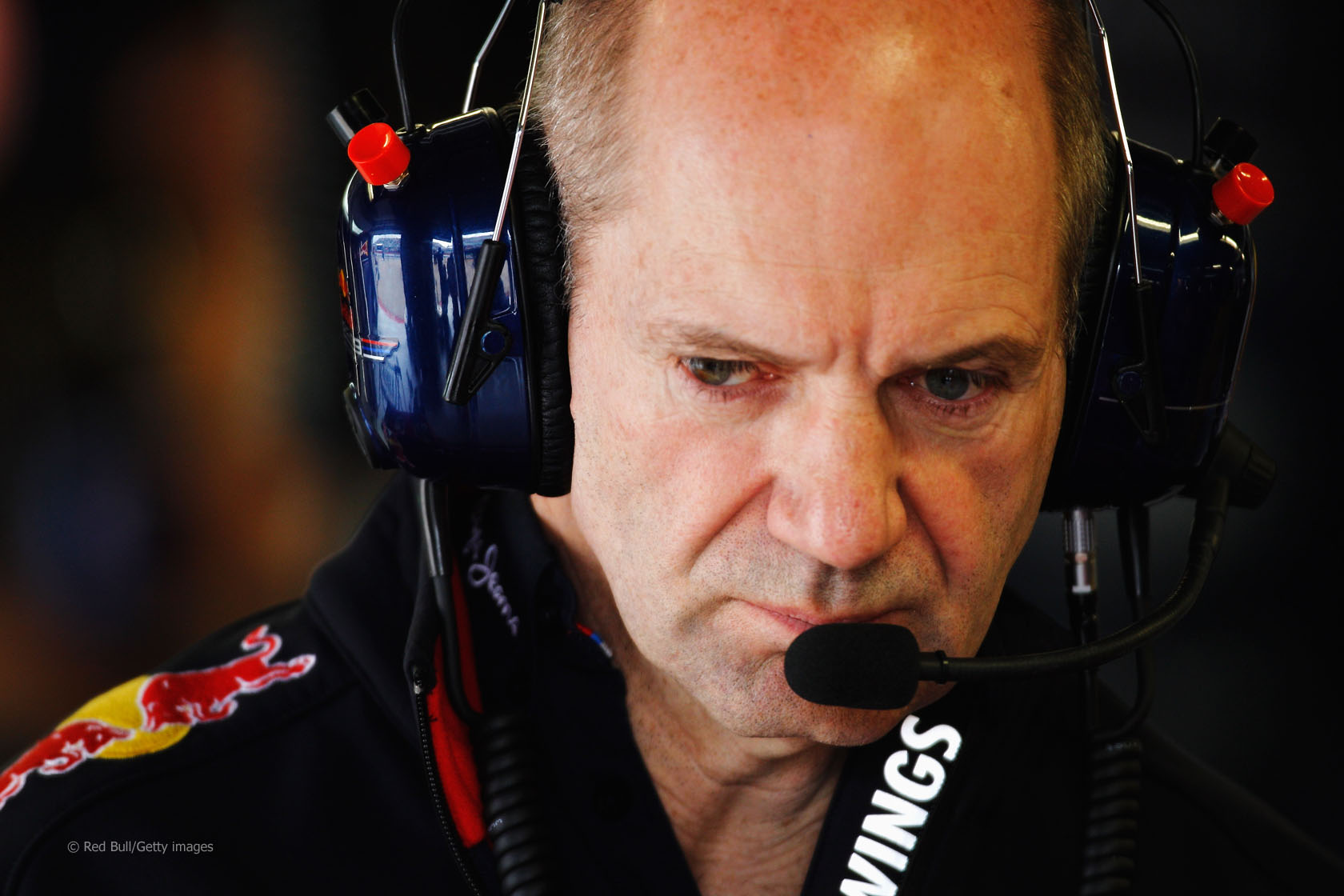
The most successful design engineer in F1 history.

Adrian Newey, the most successful design engineer in F1 history.

Newey who is unenamoured with the tightly controlled regulations currently in force in F1, believes they are so constrictive that, “the regulations design the cars.” Even as recently as two races ago in Germany the FIA outlawed FRICS, a front and rear interconnected hydraulic/mechanical suspension system which some teams had been using since 2010.

So disappointed is Newey with F1 he is stepping back from hands-on involvement at the end of the season with the Red Bull Racing F1 team. He has signed a new deal, where from next year he will be involved in Red Bull Technologies special projects, one of which is believed to be Britain’s America’s Cup challenger.

Newey, of course, has always had an uncanny ability to exploit the “grey” areas of the regulations on his way to designing F1 cars for the Red Bull team that have won four constructors and four drivers world championships between 2010-2113.

Four time World Champion Sebastian Vettel in the RB10.

Four-time World Champion Sebastian Vettel in the RB10.

But as justified as the analogy between F1 and MotoGP is, the ongoing homogeny in technical terms for Grand Prix motorcycle racing is to a degree mimicking F1 and is of great concern for the “purity” of the sport. Let’s not forget that F1 supremo Bernie Ecclestone created Two Wheeled Promotions to form a joint venture with Dorna Sports in the early 1990’s to acquire the commercial rights to the motorcycle Grand Prix from the FIM. Ecclestone sold his companies interest to Dorna and its CEO Carmelo Ezpeleta has often looked to F1 for inspiration, “to improve the spectacle.”

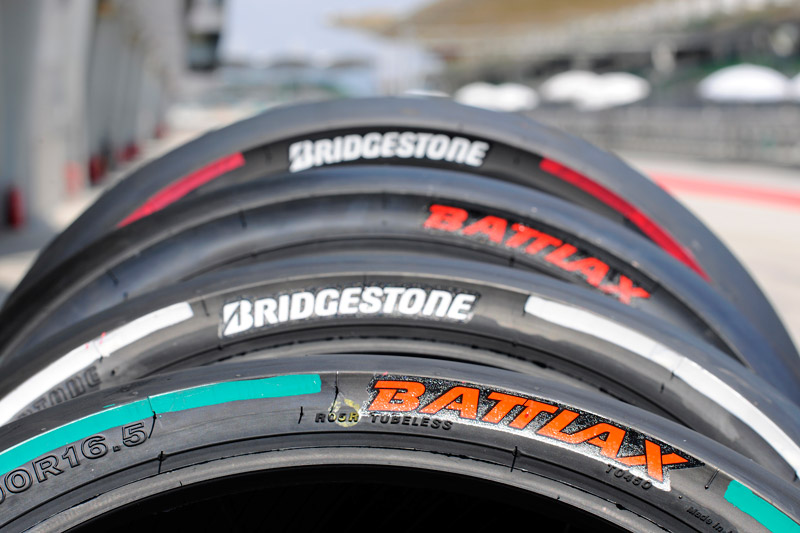
We now have a situation in MotoGP where, just as in F1, there are colour coded control tyres, a freeze on engine development for the “factory” machines during the season and a limit on the number engines available. Which for 2014 can only consume a meagre 20 litres of fuel per Grand Prix. In 2016 it will also be mandatory for all the MotoGP teams to use a Dorna supplied ECU and software.

One significant difference, however, is the use of traction control in MotoGP. Banned initially in F1 in 1994 and backed up with the introduction of a standard FIA ECU in 2008, some MotoGP riders and a proportion of the fans are against these electronics as well, as it’s seen as an artificial enhancement of a rider’s ability. But it is also a concession by Dorna to maintain motorcycle manufacturer involvement, who have to justify the enormous expenditure required to go Grand Prix motorcycle racing and who have traditionally seen MotoGP as part of their research and development programs that filters new technology down to their road bikes.

F1 like colour coding of MotoGp tyres.

F1 like colour coding of MotoGP tyres.

The same is true of the new regulations in F1 with the return of a smaller capacity 1.6litre fuel-efficient turbocharged V6 engine that use a more complex hybrid energy recovery systems. Again, if the changes had not happened Renault and Mercedes may have withdrawn from F1, as they too have to justify the massive expenditure to go racing to their respective boards and shareholders by developing technology that is relevant to the road cars they build and sell. Nonetheless, the real racing person that Newey is, he describes F1 as becoming an “an engine formula.”

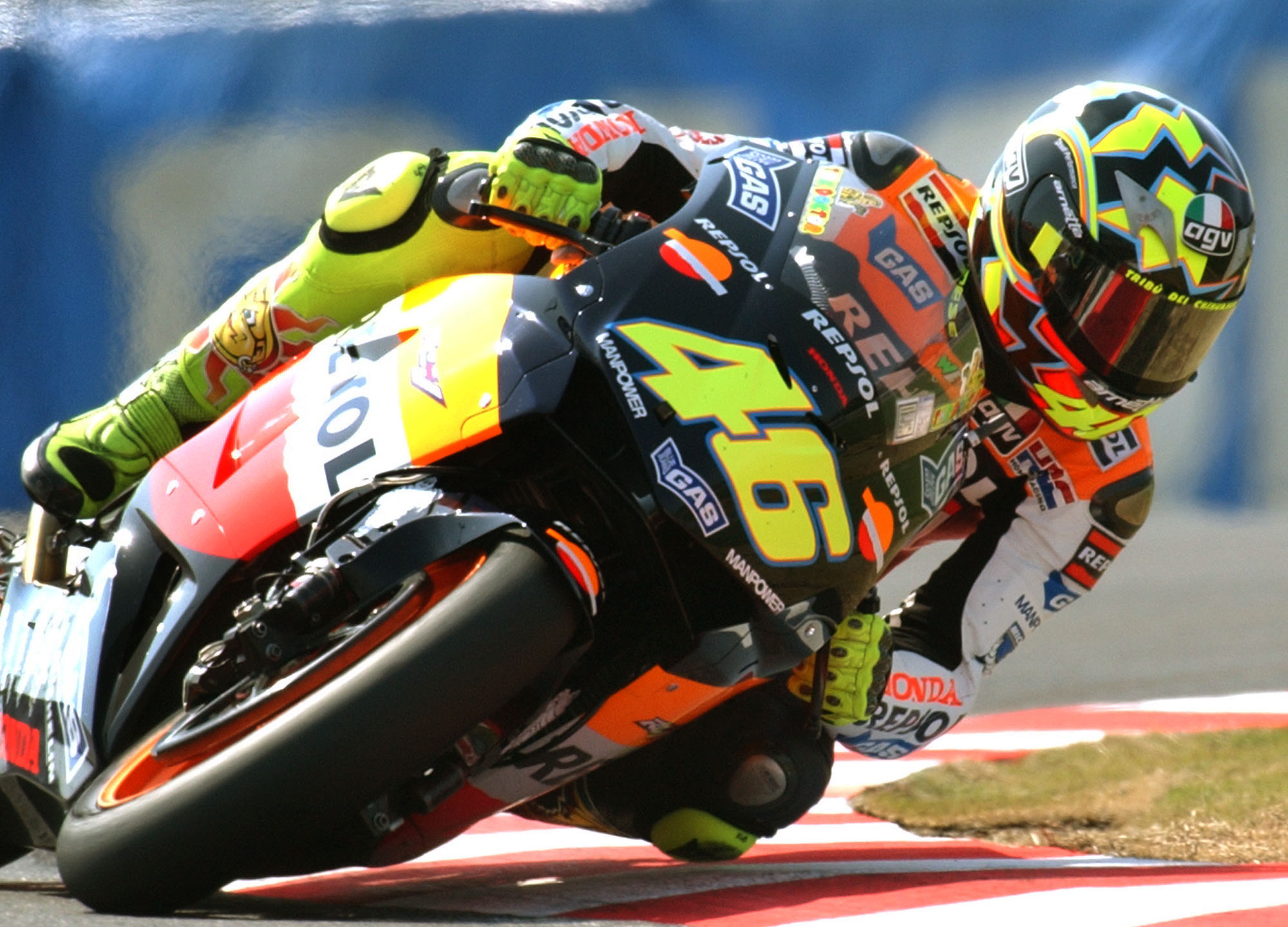
However, regardless of electronic rider aids and constrictive regulations, MotoGP racers by the very nature of motorcycle design are themselves “part of the machine”. Where they place their body weight under braking or going around a corner and accelerating out of a corner has a significant impact on lap times. Indeed MotoGP racers use everything available to them to go as fast as they can, carving angles of lean through bends that defy the laws of physics, and dragging not just their knees but also their elbows on the tarmac.

They also, thankfully, have no radio hookups with the pits and a team of technicians reading telemetry telling them what to do, only pit boards and their own judgment for tactical use of their fuel and tyre consumption over the course of a race.

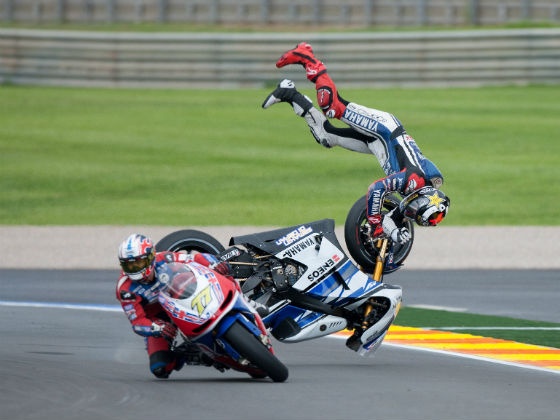
Jorge Lorenzo becomes airborne trying to avoid backmarker James Ellison.

Jorge Lorenzo becomes airborne trying to avoid backmarker James Ellison.

Also, these racers are not strapped tightly into a safety cell with only a low percentile chance of serious injury should they crash, as is the case in F1. And regardless of the current technology MotoGP riders do crash regularly, and often spectacularly, suffering abrasions and broken bones. Ask Jorge Lorenzo, Dani Pedrosa and Cal Crutchlow to name a few. No matter what the technical regulators do to the sport of MotoGP, that innate, spectacular and highly dangerous involvement of the motorcycle racer themselves does indeed make them “superhuman.”

Words Geoff Dawes © 2014.  Images courtesy http://www.f1fanatic.co.uk, http://www.nhatnet.com, http://www.vroom-magazine.com, and http://www.zigwheels.com

The Double

Bluebird CN7 sits poised on her built-in jackass Lake Eyre In South Australia.

The year 2014 marks the 50th anniversary of Donald Campbell’s incredible double world speed records set on both land and water. No other person has ever achieved this mammoth feat in the same calendar year, and it is highly unlikely that it will ever be repeated.

As a boy living in England, I was aware of Campbell and his achievements, and it was a shock to see the terrible accident on television that claimed his life on January the 4th 1967 on Coniston Water in Cumbria. It was a moment from the 60’s that stayed with me.

The following month, in February 1967, my family immigrated to Australia, and little did I realise when we settled in South Australia that this was where Campbell had broken the World Land Speed Record.

Some years later, in 1981, two wonderful articles appeared in “Wheels” magazine, which rekindled my interest in Campbell. Written superbly by Evan Green who was Ampol’s Project Manager for the record attempt at Lake Eyre, it gave a remarkable insight into Campbell and the struggles he faced with the record attempt while trying to overcome his own demons.

This set me on course to gather a wide range of research material on Campbell that has continued this day. Part of this journey back in 1991 resulted in funding from FilmSouth, to write a two-part TV mini-series about the events at Lake Eyre. Unfortunately, the project fell over several times due to circumstances beyond my control.  However, in 1997, I had feature articles published about the record attempts in both Australia and the U.K., while appropriately this July I have an article entitled  “The Double” in SALife magazine.

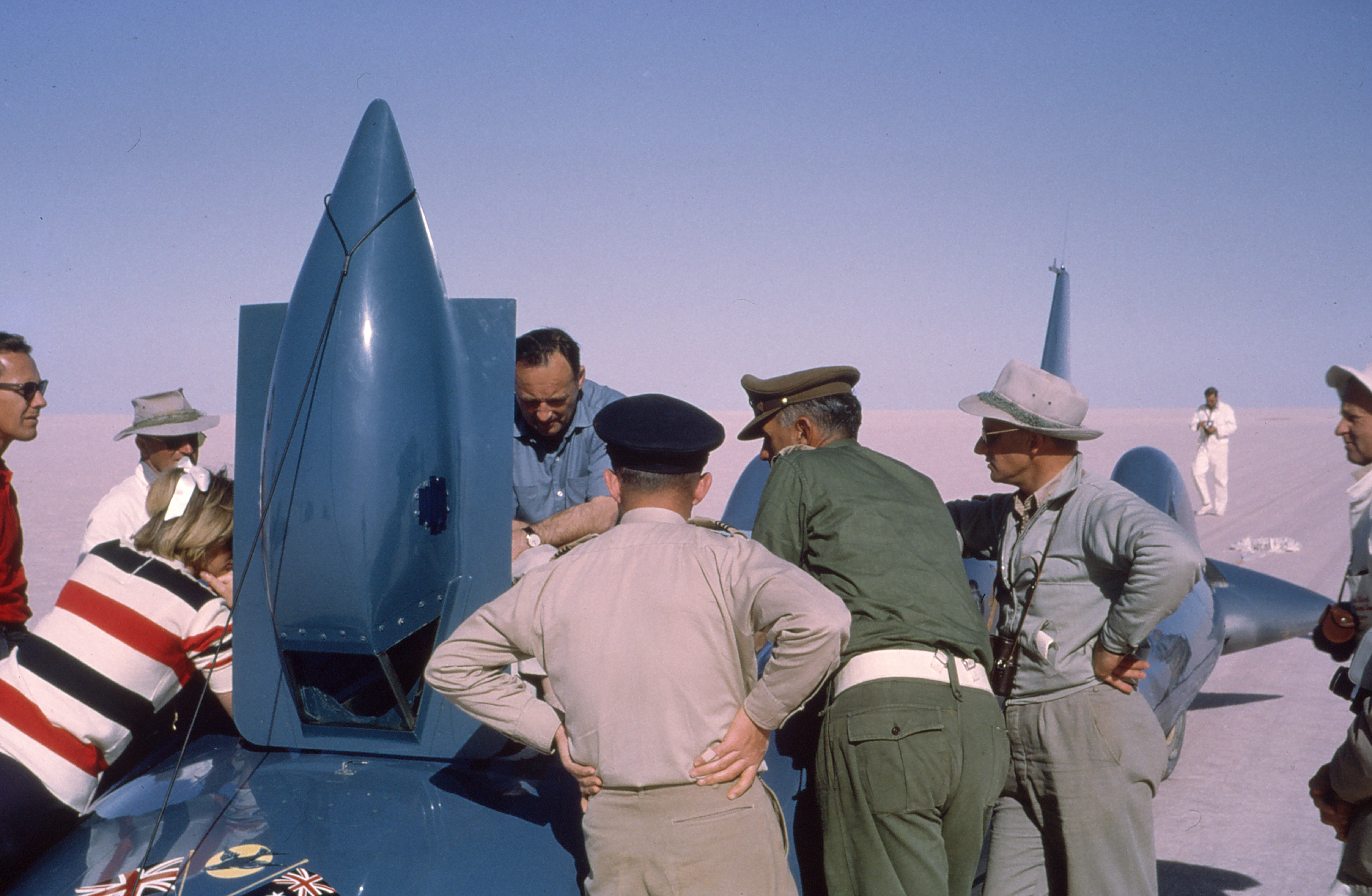
Campbell discusses problems with the track to his team.

Campbell discusses problems with the track to his team.

My reason for mentioning all this is that for many years to have an interest in Donald Campbell was akin to being a Bluebird “anorak”, and at times it seemed as though there was a certain amount of apathy towards his achievements.

But what is refreshing, in this 50th anniversary year, is that the communities in Australia that were touched by his record attempts are coming together to celebrate them.  Thanks to those that were involved in some way with the record attempts and others that witnessed them or have heard anecdotes from friends or family, there has been a groundswell of community support.

The people of the Shire of Dumbleyung in Western Australia have been gearing up for a big 50th celebration of Donald’s World Water Speed Record, set on December 31st, and they would welcome any visitors to share in the new years eve celebration. The Dumbleyung Bluebird committee is building a full-size replica of Bluebird K7 and has acquired a former post office building that will become a Bluebird interpretive centre.   Donations to their fund are welcome, and they have a terrific web page at www.dumbleyungbluebird.com.au as well as a great Facebook page.

Jean Pearse captured the scramble to get the World Water Speed Record with only hours of light. remaining

Jean Pearse captured the scramble to get the World Water Speed Record with only hours of light. remaining

In South Australia, the community of Barmera is also fundraising towards building their own Bluebird K7 replica to be placed on the shore of Lake Bonney where Campbell set an Australian National Water Speed record on November 23rd, 1964, before it proved unsuitable for the world record attempt.  The Barmera committee is also working hard towards establishing a Campbell and Bluebird museum as well. Their 50th-anniversary celebrations will take place over the weekend of November 22nd-23rd.  They also have a very good web page at www.k7projectbluebird.net and also an excellent facebook page.

Perhaps the most pleasing thing that has occurred through these hard-working community committees is a significant number of unseen photographs, movie films and personal recollections that have surfaced on these marvellous websites for everyone to share.  And just as importantly they are helping Donald Campbell’s outstanding achievements finally get the kind of recognition that they really do deserve.

Words Geoff Dawes © 2014 Photographs John Workman and Jean Pearse  © 1964. Video courtesy www.dumbleyungbluebird.com.au and YouTube.

Archives: Could Your Helmet Kill You?

I am a big fan of motorcycling commentator, Boris Mihailovic, and have always enjoyed his comments and views in Australian Motorcycle News. But it came as a shock to learn through his column of a recent nasty altercation with a car that left him with a broken neck and severely broken wrist.  In his article, he noted something that the Orthopaedic Surgeon had told him with some surprise. Boris was informed that his open face helmet had probably saved his life. According to the surgeon, a full face helmet may have inflicted a more severe impact on his C2 or “hangman’s” vertebrae which could have been fatal.

This resonated with me as 25 years ago I wrote a news story for Bike Australia that covered the research findings of the world famous Royal Adelaide Hospital Craniofacial Unit.  The following is the news item that included this particular discovery in 1989.

*                                             *                                        *

IMG

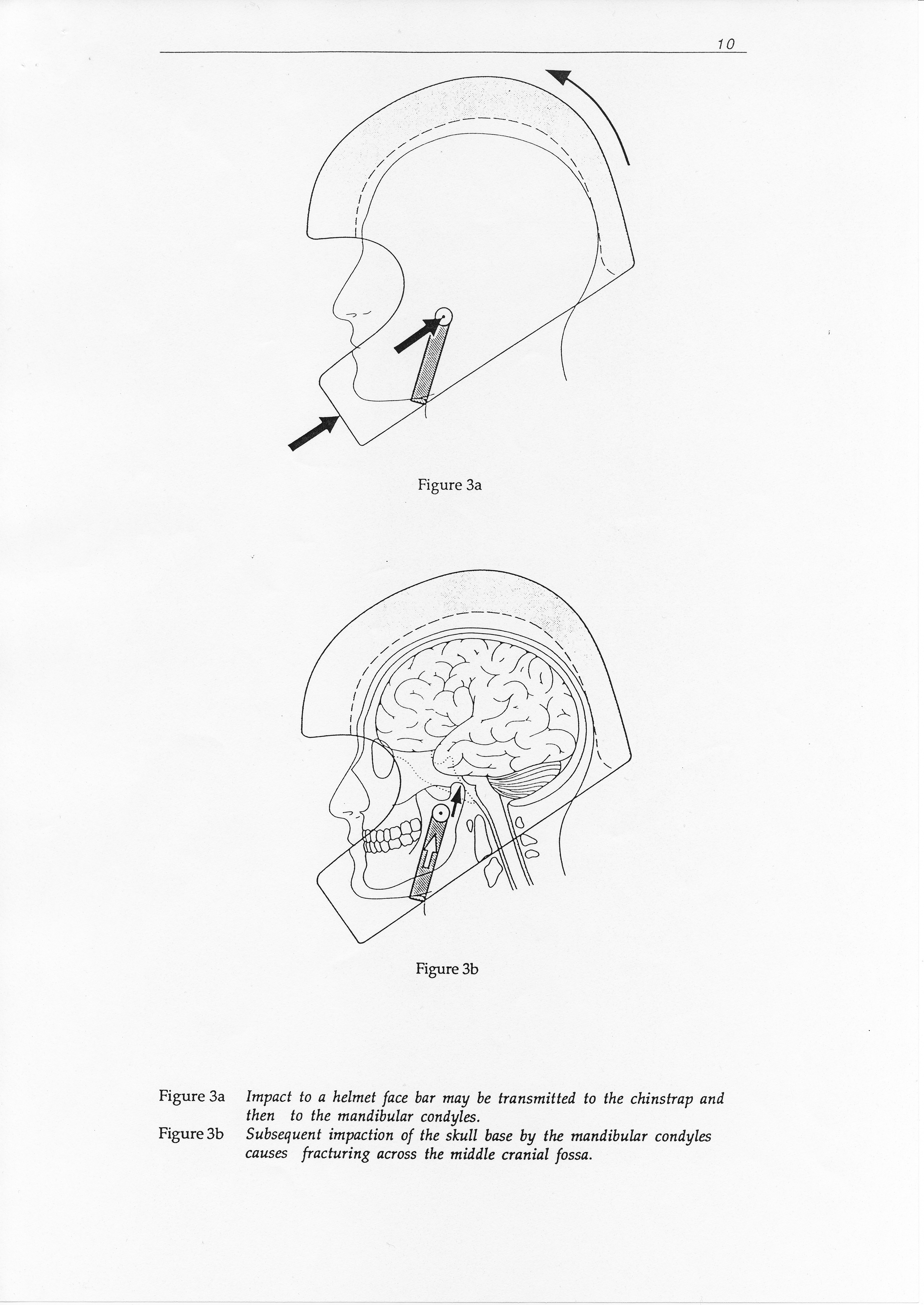
Illustrations from Dr Rodney Cooters overview document “Motorcyclist Craniofacial Injury Patterns”.

A significant flaw in the design of full-face helmets has led Adelaide’s world-renowned craniofacial unit to design a safer motorcycle helmet.

In previous years some brands of full-faced helmets had been criticised due to the lack of a cutaway in their rear edge, as this was thought to cause neck injuries.  However, the Craniofacial Unit head, Professor David David, and researcher, Dr Rodney Cooter, found an even more serious problem with the basic design of the full-face helmet. “We discovered modern helmets have an Achilles heel.  They have been designed to prevent facial injury and are extremely successful, but because the face bars are so rigid they can occasionally result in the death of the wearer,” Mr David said.

For some years medical authorities have been puzzled by the number of fatalities due to brain damage, even though the motorcyclists were wearing full-face helmets and showed no visible facial injury. It was found that the chin piece of a full-face helmet can transmit the force of an impact back and upwards via the chin strap to the jaw and skull.  This can result in a skull base fracture, which in turn can cause the brain stem to tear.  “Ironically where crash survivors suffer facial injuries, they often have no brain damage because the face absorbs most of the impact.”

Diagram examples from Dr. Cooters overview document Motorcyclists Craniofacial Injury

Many hours of research was undertaken by Dr Rodney Cooter with the help of the Accident Research Unit at the Adelaide University, the State Coroner, the Forensic Science Centre, the Royal Adelaide Hospital, the Adelaide Children’s Hospital, the Institute and Veterinary Science and the Police. The Craniofacial Unit then sought the help of the South Australian Centre for Manufacturing at Woodville, where engineers Dr Fred Zoeckel and Mr Ralph Smith used computer imaging to come up with alternative full-face helmet designs.

Provisional patents have been taken out on several designs that alter the chin straps and insert movable cheek bars or alternatively utilise a special inner helmet which moves independently of the outer shell.  It’s hoped that a major manufacturer will produce the new designs. However, it was stressed that a conventional full-face helmet was much safer than no helmet at all.

Part of the helmet design that shows the internal chin pads.

Part of the helmet design that shows the internal chin pads.

Dr Rodney Cooter has been invited to deliver a paper on the research at the 1990 International Conference of the Motorcycle Safety Foundation in Orlando, Florida USA.

As a next step towards producing a working prototype of these new designs, Dr Cooter will hold discussions with Bell Helmets in Los Angeles during his visit.

*                             *                                 *

It seems quite astonishing that after a quarter of a century since the Royal Adelaide Hospital Craniofacial Unit produced the ground breaking research of Dr Rodney Cooter, no motorcycle helmet manufacturer has been able to address this fatal flaw in full-face helmet design.

Words Geoff Dawes (C) 1989/1990. Images courtesy the South Australian Centre for Manufacturing. Published in Bike Australia.

Archives: The Enfield India 350cc Bullet

A classic frozen in time.

Earlier this year Royal Enfield Motorcycles released its latest offering to the motorcycling world in the form of the stylish 2014 Continental GT that was Inspired by the 1960’s 250cc model of the same name. The official world launch of the new Enfield was at the iconic Ace Café in London which made an appropriate backdrop to the retro café racer styling. It is arguably the most modern of Enfield’s eleven model lineup; all based on the same basic architecture of the 1955 Royal Enfield 350cc Bullet. Royal Enfield, formerly Enfield India, has come a long way since the parent company was liquidated in 1971. The manufacturer now exports to numerous countries around the world and offers a range of apparel and riding gear with events designed to engage Royal Enfield enthusiasts in a way that many manufacturers use to make buying a new motorcycle a lifestyle choice.

The latest in Royal Enfield's model line-up the 2014 Continental GT.

The latest in Royal Enfield’s model line-up, the 2014 Continental GT.

But in 1988 the Enfield India Bullet was little known outside of the sub-continent. What follows is an article that I authored for Bike Australia in 1988 and perhaps charts some early small steps by Enfield to once again become a world brand.

*                            *                            *

The Enfield name can be traced back to the middle of the 19th century when George Townsend and Company was founded in the Hamlet of Hunt End near Redditch in Worcestershire to make sewing needles and machine parts. They became involved in bicycle manufacturing in the 1880’s and in 1890 began producing their own brand of bicycle. Two years later the company changed its name to Eadie Manufacturing and for the first time used the Enfield name for a new range of push bikes due to a contract with the Royal Small Arms Factory at Enfield in Middlesex.

In 1890 the name  “Royal Enfield”  was licenced by the crown and the slogan “made like a gun” with a field gun trademark was adopted. Their first powered machine was a quadricycle built in 1898 using a De Dion power plant, and in 1901 they made their first motorcycle that featured an engine over the front wheel powering the back wheel by a crossed over belt.

It wasn’t until 1910 that Enfield became a serious motorcycle manufacturer when they started to produce large capacity V-twins. By the late 1930’s Royal Enfield were manufacturing quite a comprehensive range of machines, mainly singles of 150cc, 250cc, 350cc, 500cc and 570cc capacity with side and overhead valves as well as a small capacity two-stroke and a 1140cc side valve V-twin.

The “Bullet” range was first introduced in 1933 to satisfy the taste of more sporting riders. These were based on the standard models but with improved performance. Enfield though centred its competitive outings to off-road competition, which were mainly trials events. This fitted well with the Enfield image of uncomplicated, reliable motorcycles, suitable for everyday transport and the occasional weekend sporting event.

Simplicity, headlight switch, speedo and ammeter mounted in the headlight shroud.

Simplicity, headlight switch, speedo and amp-meter mounted in the headlight shroud.

It was after the Second World War when the needs for basic transport had been satisfied that Enfield decided something a little more exciting than their prewar and wartime models was needed to keep its customers happy. So in 1948, the first prototype of a new model 350cc Bullet was seen in the Colmers Cup trial ridden by the works team. They caused a bit of a sensation at the time because they used a rear swinging fork suspension, which was unheard of in trials at that time.

They had limited success first time out but soon showed their form by winning gold medals later that year in the International Six Day Trial as part of the winning British trophy team. The road going version was put into production in 1949 with a listed price of  £171 9s  0p alongside competition versions for scrambles and trials. These differed only in minor details such as compression ratio, exhaust system, tyres and the general equipment fitted.   Relatively little had to be changed from one model to the other, and all were very much like the original prototype.

In 1955 Royal Enfield received an order from the Indian government for eight hundred 350cc Bullets for the Indian Army and Police. I was such a large order the company decided to set up an assembly plant in Madras India (now Chennai) for the 1955 model 350cc Bullet. In 1957 tooling equipment was sold to Enfield India Ltd. and in 1958 the first Indian made Bullet rolled off the production lines and is today still being produced virtually unchanged.

The Bullet ceased production in England in 1962 and the company folded in the early 70’s.  Part of its legacy being the surviving Indian company (it also seems ironic that the big 700-750cc Enfield twins used in the Constellation and Interceptor models were sold in the States as “Indians” after the famous American marque which coincidentally used modified Bullet barrels and heads).

A real coals to Newcastle situation occurred in 1977 when British Laverda importer, Slater Bros, started bringing Indian Bullets into the UK. Some were unsuccessfully imported into N.S.W. in the early 80’s, but ADR compliance was never acquired.

It took a South Australian company to finally get the Bullet to Australia and onto the showroom floor. Ron Lewis’ company T.A.S.C. Imports are part of a family business that has been involved in the automotive field for some sixty years. They specialised in importing American cars and parts and in 1971 were also importing Harley Davidson motorcycles.

Unfortunately, the introduction of Australian Design Rules made it impossible to import complete cars, and they also stopped importing Harleys – which is a bit of a sore point with Ron as at that time it was impossible to foresee the resurgence of that marque in Australia. T.A.S.C. now imports new and used car components for British, European and American cars as well as the Enfield India Bullet, which they distribute under the name Enfield Cycles Australia.

Igjition switch is housed in the side cover.

The ignition switch is housed in the side cover.

In 1984 that Ron went to India to negotiate importing the Bullet to Australia and to purchase one for compliance purposes.  This was thought to be a relatively straightforward effort. Unfortunately, it wasn’t. The major problems were with the exhaust system and brakes which were showing the modern day deficiencies of 1955 design. A new exhaust system was fabricated by Quad Pty Ltd to bring the decibels down to the required number, while Amdel laboratories helped in converting the front one-inch drum brakes to four inches in width and they also increased its mechanical advantage.

Finally, three years later, the Enfield India Bullet achieved compliance with the factory adopting Ron’s improvements on all Aussie bound Enfield’s. One thing the factory had improved over the years was the electrical system – the original magnet dynamo being replaced with a distributor and alternator although they remained 6 volt. Enfield Cycles Australia latest shipment, however, does feature 12 volt electrics although the Bullet Deluxe will still be available in 6 volt form for those who yearn for the days when Joe Lucas was known as the prince of darkness…….

Ron was kind enough to lend me a brand new Bullet Deluxe for a ride impression and to photograph. So it was with little trepidation that I arrived at Glynde Auto Wreckers to pick up the demonstrator as I hadn’t ridden anything quite like the Bullet before.

Like any motorcycle with character, there is a definite procedure to starting it. First turn the right-hand side toolbox mounted ignition switch on, turn the petrol on, put the choke on, pull the left handlebar-mounted decompression lever in, kick the engine over until the amp-meter needle swings over to the left – then give it a good kick in the guts! This generally does the job and you are rewarded with one of the best sounds a motorcyclist can hear – the classic sound of a British four-stroke single.

Decompression lever aids kickstarting the 350cc single.


Decompression lever aids kick-starting the 350cc single.

First gear is relatively high, so it takes quite a few revs and a little bit of clutch slip to get it going, but the exhaust makes such a glorious racket that it’s thoroughly enjoyable. The gearbox is relatively slow and needs a positive movement to engage the gears correctly, while second and third gears are relatively close in their ratio’s which helps to keep that lovely exhaust note rising and dipping until fourth gear is engaged with a noticeable drop in revs and flattening of the exhaust note. It’s such a relaxing bike to ride, and apart from the exhaust (which is so enjoyable anyway), it is a very unobtrusive motorcycle.

The ride is firm but well controlled, it handled nicely with a solid feel to it that inspired confidence. Ron pointed out that a properly run-in Bullet should touch around 120kph and be capable of returning an impressive 4.5 lt/100km from its 14.5-litre tank. The only problem I found with the Enfield was the brakes, which hadn’t bedded in fully and it took a fair bit of effort to get the Bullet stopped.

Apart from that, there are a few minor ergonomic niggles that are part and parcel of owning a motorcycle that was first designed in 1948. The Bullet does, however, feature some excellent design ideas, such as the neutral select lever, which is handy at traffic lights, and the snail cam adjusters on the rear wheel to keep the chain correctly tensioned.

The Enfield sports two good sized tool boxes which allow extra room for more tools (the standard toolkit is quite reasonable) and a puncture repair kit. Another nice feature is the single large alloy primary drive chain cover. It has a single central retaining bolt, which apart from its aesthetic appeal makes it very easy to work on the primary drive chain. The finish of the Bullet is pretty good too – it’s nice to see so much chrome on a production motorcycle again. The seat is trimmed by hand, and the pin-striping on the tank is also by hand.

There are 1,864 parts that make up a Bullet and Ron has at least one of all of them so spares should not be a problem and it’s also a boon to restorers of this classic design. At the moment Enfield Cycles Australia have two versions of the Bullet available, the Deluxe and the Super Deluxe costing $4,460 and $4,940 respectively, with a more modern looking version the Bullet Super Star on the water.

Another interesting aside of Ron’s involvement with the Enfield India Company was that it encouraged them to set up an export department, which bore the fruit of a shipment of Bullets to Japan that coincided with the first Australian shipment. A business associate of Ron’s in the States, Joe Cody of Pacific Automotive Exports in Washington State, is also taking them on for American consumption. Enfield Cycles Australia’s network has dealers in most States, but they would like to expand the number of outlets further and are in the process of looking for interested dealers.

At home anywhere in the world.

At home anywhere in the world.

It’s hard to adequately define a niche in the marketplace the Enfield will fill. As Ron pointed out if there is a “type” of buyer for the Bullet it appears to be a more mature gent who owned something similar as a lad and is now in a position to purchase a one for the occasional Sunday ride. Some may say that a true British bike enthusiast might sooner spend the time and money on restoring the “real thing” than purchasing an Indian “replica”. But for me, the Bullet acts as a time machine transporting every sense of its rider to an uncomplicated era in motorcycling that must have been a lot of fun!

Words and photographs Geoff Dawes © 1988.  Published in Bike Australia 1988. Image http://www.helmetstories.blogspot.com.

Archives: BMW Turbo Twin

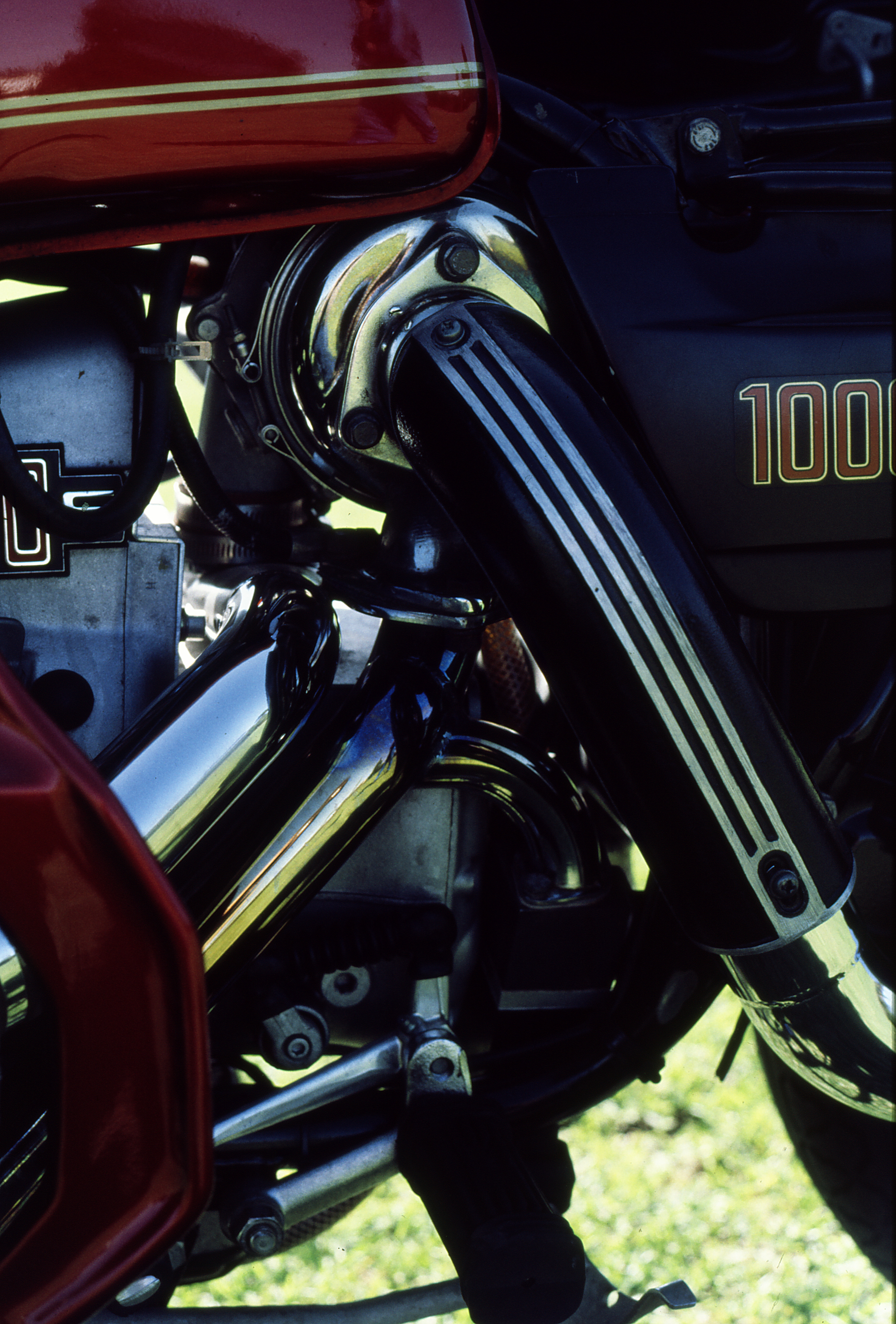
Installation of the Turbo and plumbing is extremely neat.

Over the years BMW has achieved enormous success in the most diverse forms of motorcycle racing, with what is the same basic “flat-twin” engine design first introduced in 1923 with the R32.  Successes include winning the first European 500cc Championship in 1938 with a supercharged version of the flat-twin configuration.  From 1954 to the mid 70’s BMW flat-twin engines dominated World Championship Sidecar Racing and also during the 70’s came an AMA Superbike Championship and a win in the Castrol Six-Hour Production Race. BMW has also had successes with this design in the most gruelling off-road race of them all, The Paris to Dakar Rally.  The list goes on and on, yet most people look upon BMW’s R series flat-twins as nothing more than reliable tourers.

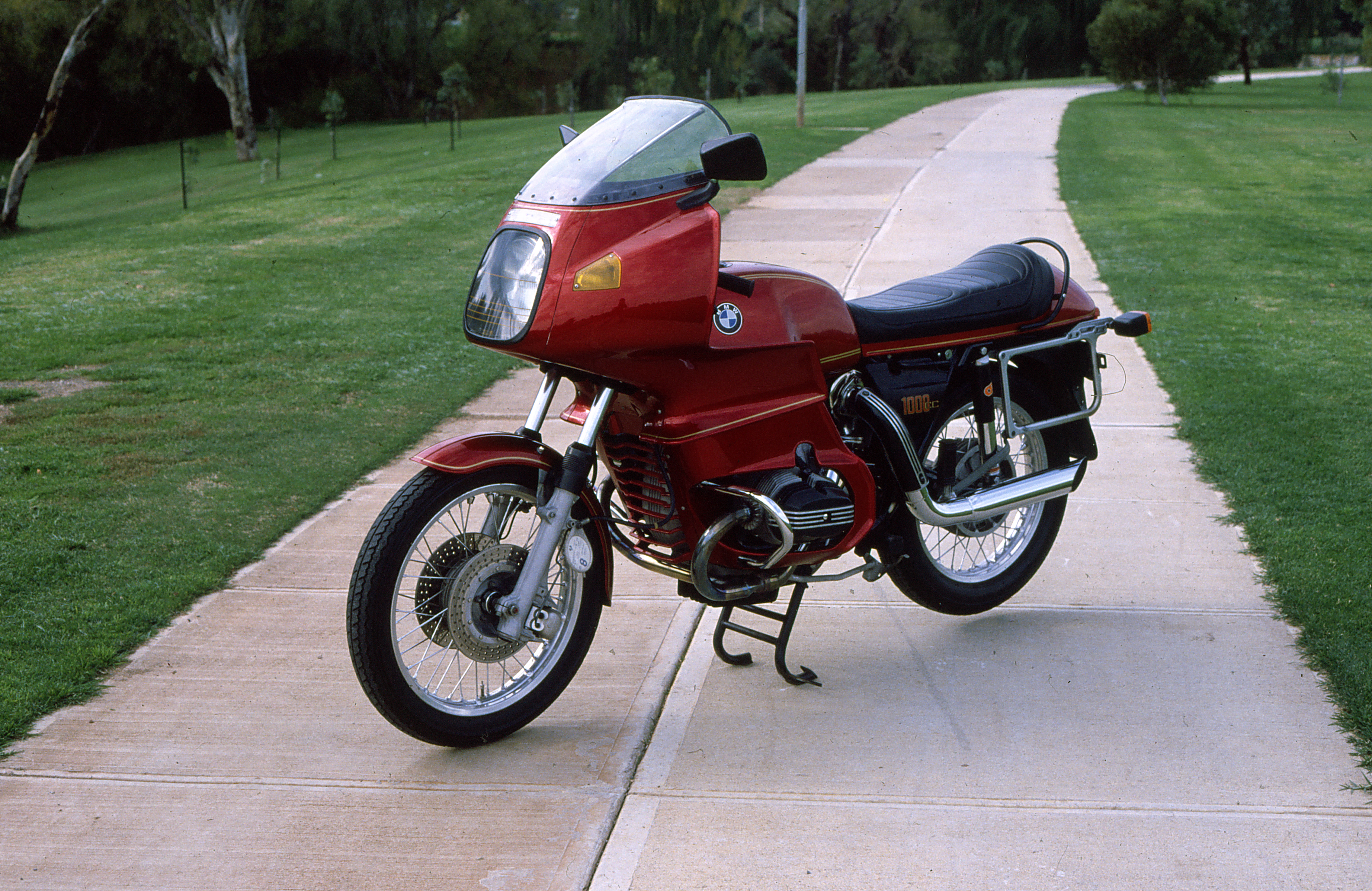
Anthony Steele’s 1979 R100S has perhaps caused a few people to think differently about this iconic design.  Tony’s bike, you see, has the ability to change from a mild-mannered tourer to an arm-stretching superbike at the twist of a throttle.  The transformation is brought about by current technologies answer to the supercharged BMW’s of the late 1930’s; the turbocharger.

Tony, who is a mechanic by trade, decided to turbocharge his bike in the early 1980’s at a time when spectacular claims of power and economy were being made for this form of forced induction.  Aftermarket turbo-charging kits were proliferating in the States with some finding their way to Australia.  The American Turbo-Pak kit fitted to Tony’s bike was acquired through the SA importer and distributor of BMW, Pitmans.  The package included a Rajay Industries turbo unit with adjustable wastegate, a Zenith side-draught carburettor, an electric fuel pump plus a larger capacity sump and all the necessary plumbing.

IMG_0002

Turbo-Pak kit tucks well out of the way.

According to Tony fitting the turbo kit was reasonably straightforward.  The battery under the seat had to be replaced with a smaller unit and tilted back to clear the turbo housing.  After some problems with detonation, two spacers were fitted between the crankcase and cylinder barrels on each side to lower the compression ratio.  The spacers are a standard BMW part for the R90 series engine for use in countries with low octane fuel.  They required some machining of their centres to accommodate the bigger bore R100 engine.  A lumenition electronic ignition was also fitted for more precise combustion.  Once installed the kit integrates well with the standard layout of the bike, only the loud exhaust note and lack of right-hand side muffler gives away the fact this is no ordinary BMW.

Starting the bike takes a bit of a knack as there is no choke fitted.  A few twists of the throttle to prime the carburettor usually does the trick and once started the throttle needs to be blipped for several minutes until the engine is warm.  It then settles down to a reasonably fast 1,500 rpm idle.  The exhaust note is nothing like a regular R series BMW, sounding more like a British vertical twin with sports mufflers.  According to Tony maximum boost of 10 psi comes in between 6,500 rpm and 7,000 rpm with a claimed 40% increase in power.  More importantly, though, the engine comes on boost as low as 4,500 rpm and is making 5 psi of boost by 5,500 rpm.  In touring conditions with a pillion, the turbo BMW has a definite power advantage over standard R100S in top gear acceleration.  Tony described the engine coming on boost as similar to changing down a gear followed by rapid acceleration and even more rapidly rising engine revs.

The top speed of the R100S is entering the superbike stakes at around 210 kph (130mph), but some stability problem became apparent at 160 kph (100mph).  After trying most brands of replacement shock absorbers a pair of Fournales proved best suited to the bike, but the stability problem wasn’t entirely cured until Tony had an R100RS full-fairing fitted by Pitmans.  The standard chassis though has been found to easily handle the extra horsepower, even when accelerating hard out of corners.  Tyre wear hasn’t increased noticeably, and although the lowest fuel consumption obtained after very hard riding was 8.5 k/l (24 mpg) in regular use it has proved slightly more economical than a standard R100S.

From any angle the turbo installation is neat.

From any angle, the turbo installation integrates well with the layout of the bike.

The all up cost of the turbo kit and mods, including the cost of the ‘79 R100S, was around $8,000, although it would cost a lot more to build a replica today.  So far, only the clutch has proved to be a weak point in the drivetrain and is due for some modifications shortly, although Tony does admit the bike doesn’t like some of the extremely hot weather that South Australia experiences. At the moment four-valve heads are being looked at by Tony as the next development for what is one of the neatest turbo conversions around.

Words and photographs Geoff Dawes (C) 1983. Published in Bike Australia July 1983.

Showdown On The Salt

There are few places on planet earth that are as alien in appearance as the desolate surroundings of Bonneville Salt Flats. Situated not far from the Wendover Air Force Base in the State of Utah USA, this extraterrestrial looking terrain, covered by an expansive sheet of grubby white salt and girdled by a jagged brown-black mountain range, became an eerie backdrop for one of the greatest gatherings of outright Land Speed Record contenders the world had ever seen.

Four Americans and their streamlined leviathans assembled on the salt during a cool August in 1960 to try and break Englishman John Cobb’s 1947 record of 634.40kph (394.20mph) which for 13 years had stood unchallenged. In a flurry of national pride, it became the aim of these four very different individuals to recapture the title that was last held by the United States in 1928, when Ray Keech, driving his White Triplex Special, exceeded Captain Malcolm Campbell’s record of 333.063kph (206.956mph) by a mere 0.959kph (0.596mph).

But in 1960 the array of potential record breakers was even more formidable.

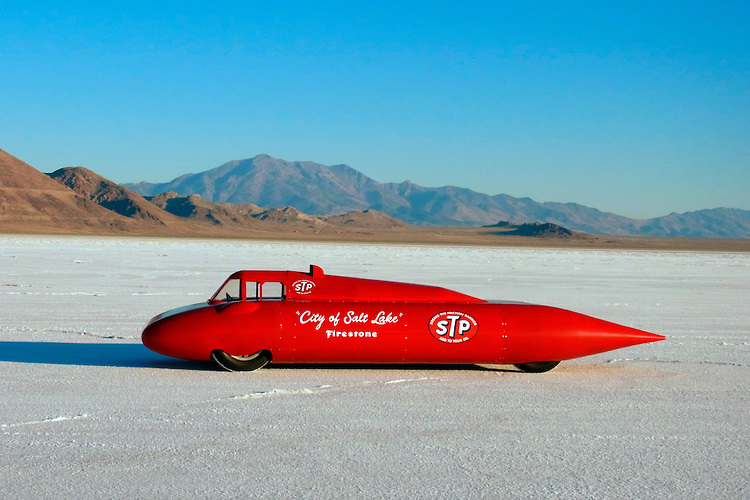
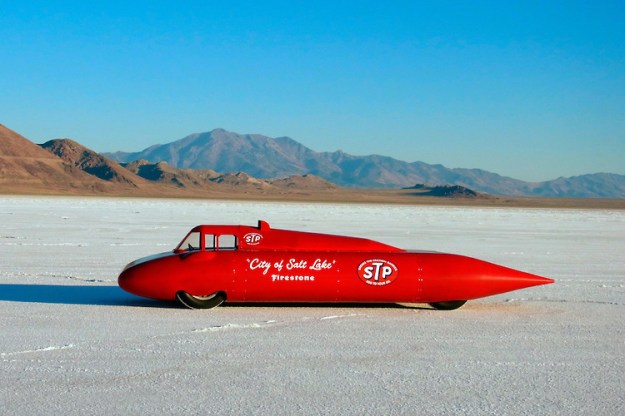
Athol Graham, a devout Mormon, had dreamed he would break the Land Speed Record and regarded it as a divine revelation.  His “car”, named the City Of Salt Lake, used the aero engine from industrialist Bill Boeings Miss Wahoo unlimited hydroplane and produced more than 2,238kw (3,000hp).  Clothed in a channelled ex-Air Force fuel drop tank, the agricultural standard of preparation had led some to consider it a “clunker”.  But nonetheless, Graham clocked a surprising 538.76kph (344.761mph) the previous December in the rear wheel drive machine on the Bonneville salt.

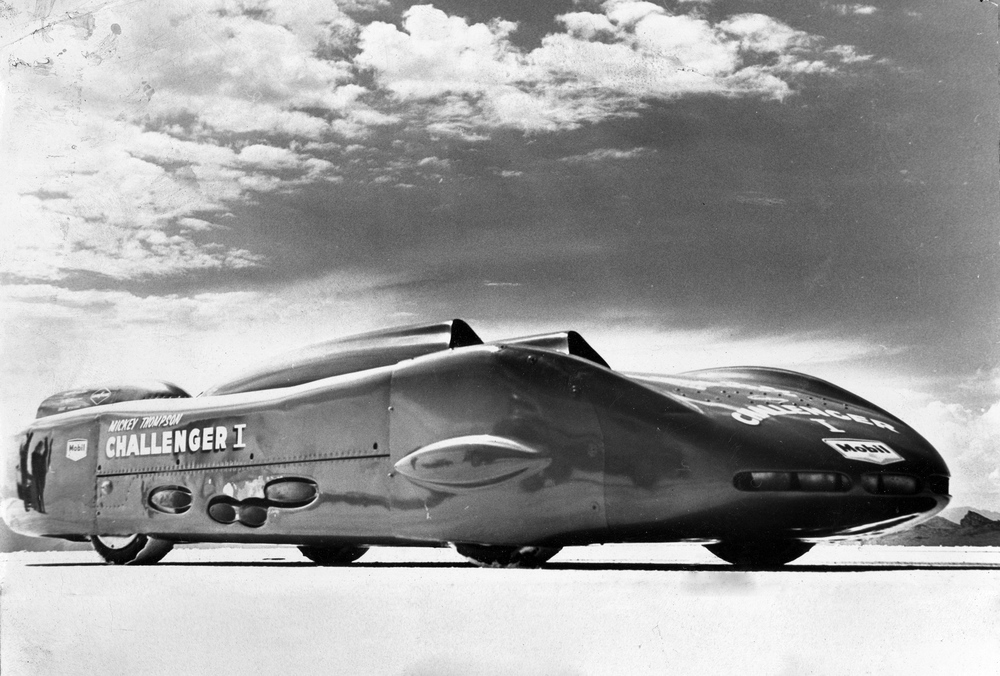
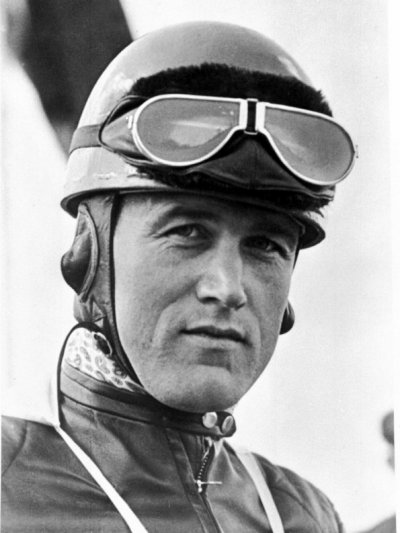
Then there was Mickey Thompson, a product of the American Hot Rod scene and the American National Land Speed Record holder.  Thompson was the most experienced of the group and undoubtedly the best prepared with his LSR car Challenger 1.  Although on paper it may have seemed an unsophisticated device, using four scrap 6.7litre V8 Pontiac engines, with supercharging it produced over 2088kw (2,800hp).  The engines were also ingeniously mounted in pairs and facing each other so the power could be transmitted to both the front and rear wheels through their own individual transmissions and final drive.

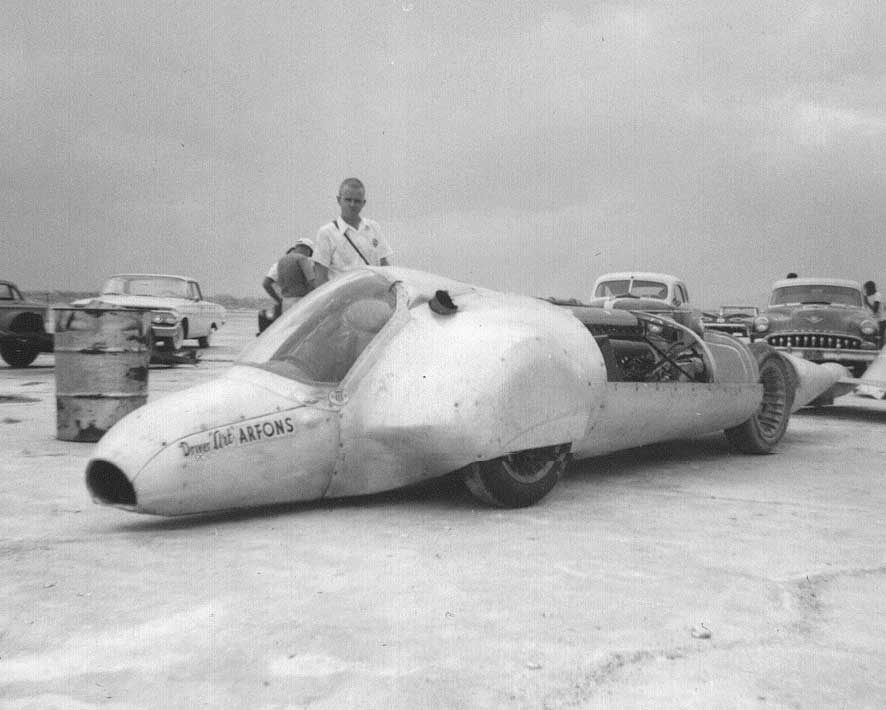
A newcomer to Land Speed Record breaking was the well-known drag racer, Art Arfons, driving number 12 in his series of soon to be famous Green Monsters. Nicknamed “Anteater” due to its long pointed snout, it used a more powerful version of the Allison aero engine than Graham’s, putting out around 2,834kw (3,800hp) in Arfon’s untried rear-engined machine.

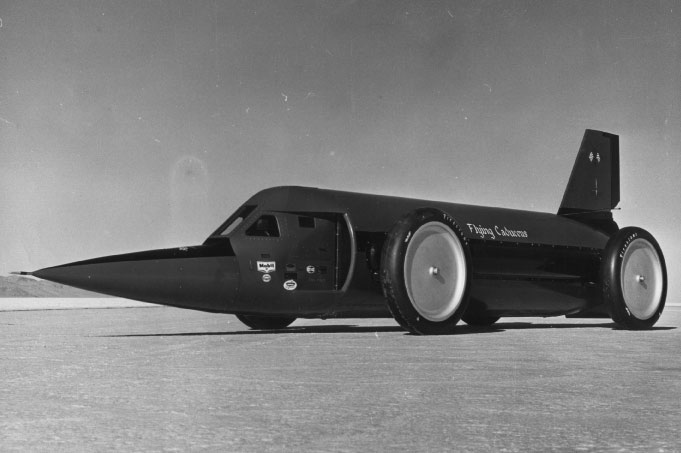
But perhaps the most amazing LSR contender of this gathering was physician Dr Nathan Ostich’s pure thrust jet engined vehicle called Flying Caduceus. Named after the medical emblem taken from Greek mythology, it used a General Electric J47 turbojet from a Boeing B36 bomber, which produced the equivalent of 5,220kw (7,000hp) and was the first of a new breed of jet-engined record contenders.  Although it was technically ineligible, according to the world governing body of motorsport, the F.I.A., Ostich was prepared to thumb his nose at the European based governing body to become the fastest man on land.
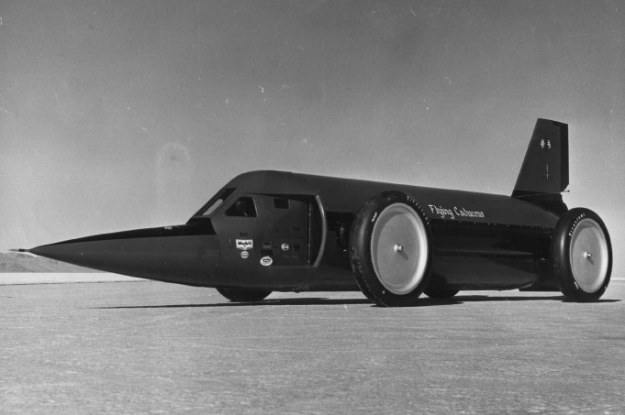
flying-caduceus015

Dr Nathan Ostich’s Flying Caduceus powered by a pure thrust jet engine.

The scene was now set for one of the great confrontations in Land Speed Record breaking history.

First to venture onto the salt was Athol Graham. Concerned about the prevailing crosswinds and some aspects of Graham’s engineering, the experienced Mickey Thompson talked caution to the Mormon idealist. Off his own back, Thompson had already asked for a telephone pole to be removed at the southern end of the course to reduce any potential risk during Graham’s run. But Graham could not be dissuaded and using full power from the Allison aero engine he rocketed his two-wheel drive vehicle flat out down the salt.  The City of Salt Lake was clocking over 482.80kph (300mph) when tragedy struck. The strong crosswinds caused the home built special to yaw off course and snap sideways into a tumble before losing its tail and becoming airborne.  With a sickening crunch, City Of Salt Lake landed upside down before rolling over and over.  There was little hope for Graham who had not worn a safety harness.  Although an inbuilt roll bar had withstood the numerous impacts, the engine firewall had crumpled, protruding into the car and breaking Graham’s spine.  He was dead on arrival at Tooele Valley Hospital 177km (110 miles) away.

If this was to be a warning of how treacherous Bonneville could be, it did not work.  Five days later 52-year-old Los Angeles physician, Dr Nathan Ostich, took his jet-powered car out on the salt.  Designed and engineered by Ray Brock, the publisher of Hot Rod magazine and hot rod doyen Ak Miller, Flying Caduceus had been wind tunnel tested at California Poly Tech, and with 5220kw (7,000hp) on hand, it was calculated to be capable of 804.67kph (500mph). But problems with a porous fuel pump, collapsing air intakes, then severe vibrations and brake and steering problems forced Ostich and his team to eventually withdraw.

Even so, the flying doctor salvaged some pride by reaching over 482.80kph (300mph) during one precarious run.
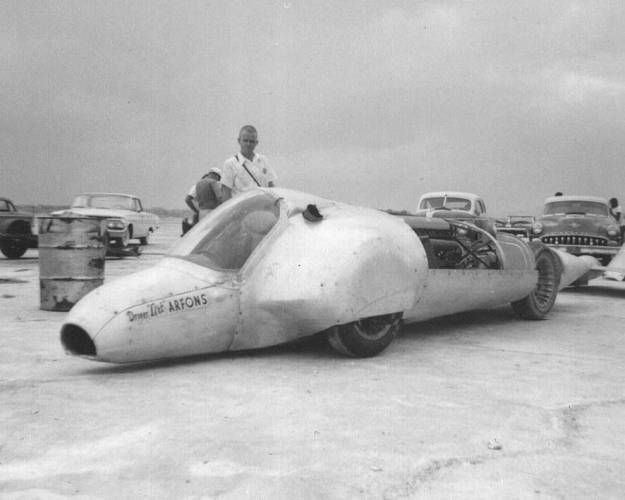
Art Arfrons contender nicknamed "Ant Eater". Its clear to see why.

Art Arfons contender nicknamed “Ant Eater”. It’s clear to see why.

Art Arfons took briefly to the salt with his Allison rear-engined Green Monster, only to have a bearing go in the cars final drive on the return run. Arfons released his breaking parachute, which then promptly snapped its nylon line.  Even though his first probe run had reached almost 402.33kph (250mph) with plenty in hand, Arfons acknowledged that “Anteater” was not up to Land Speed Record breaking standard and withdrew.

In the meantime Thompson had been building up speed, making one run at an impressive 569.70kph (354mph).  He too had been encountering problems, the suspensionless Challenger 1 suffering from a lack of front wheel adhesion, which was finally solved with some extra ballast and an aerofoil above the nose of the car.  Thompson was now ready for some serious runs, but an unexpected downpour had washed away the black guideline and the oil truck re-laying it became bogged in the mud flats.  This did not faze Thompson at all, and he elected to run without the guideline, easily managing a one-way speed of 596.67kph (372 mph).  Buoyed by this Thompson was ready to go for the record, and with his next run recorded a sizzling speed of 654.35kph (406.60mph). This was faster than Cobb’s best run of 648.783kph (403.135mph), and Thompson knew if he could get a half decent return run through the measured mile then his two-way average would be enough to beat Cobb’s record by the required minimum of one percent.  America would, at last, regain the world record.
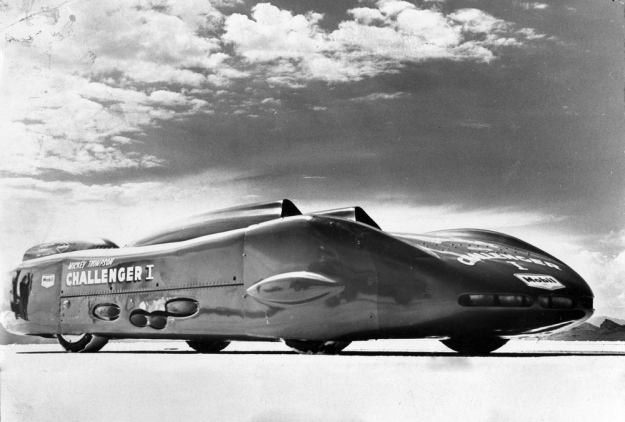
Challenger 1, Mickey Thompson's National Land Speed Record holder.

Challenger 1, Mickey Thompson’s American National Land Speed Record holder.

Regrettably, as so often happens in record-breaking, the return run was an anti-climax with Challenger 1 suffering a broken driveshaft.  Thompson did try his luck again, but this time a broken chain driving a supercharger put paid to Mickey’s dream.

There was, however, one more record contender.  Arriving at Bonneville in early September in an attempt to usurp any American record, enigmatic Englishman, Donald Campbell, returned to where his father, Sir Malcolm Campbell, had set a new outright Land Speed Record of 484.620kph (301.129mph) in 1935 to become the first man to break through the 483kph (300mph) barrier.

As a fourteen-year-old boy, Donald had witnessed his father’s triumph. Twenty-five years later and with six World Water Speed Records under his belt, Campbell was challenging for the record his father had held nine times. In keeping with family tradition Donald also named his record-breaking hydroplane and his Land Speed Record contender, “Bluebird”, as his father had, in honour of Maeterlinck’s play, “The Blue Bird”.
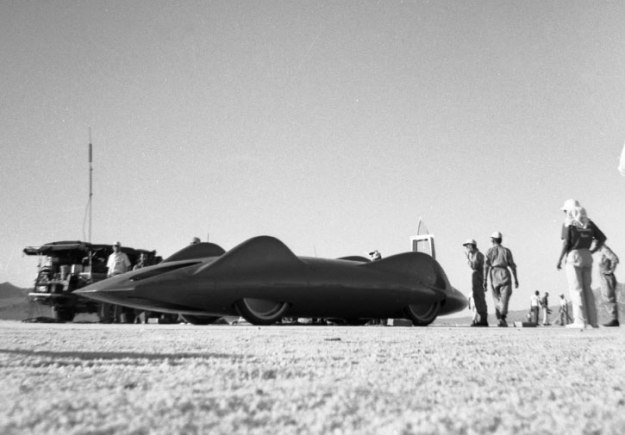
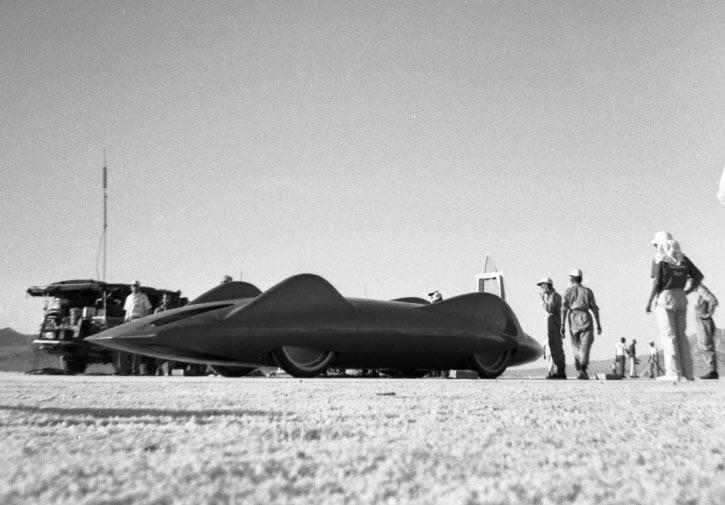
Doanld Campbell's Bluebird CN7. British pride and prestige was at stake.

Donald Campbell’s Bluebird CN7. British pride and prestige were at stake.

But if the American gang had been imposing, it was Campbell’s entourage that made the hard to impress Americans jaws drop.  With nearly a hundred personnel, forty tons of equipment and a convoy of support vehicles, it would have been hard not to gasp at the sheer size of Campbell’s undertaking.

And then there was Bluebird herself.  Designed by Ken and Lewis Norris, (who had also been responsible for Campbell’s World Record-breaking hydroplane) Bluebird CN7 had been built by Motor Panels, a subsidiary of Sir Alfred Owen’s Rubery-Owen group, with the support of approximately 80 British companies and at the cost of close to one million pounds sterling. The massive car was powered by a Bristol-Siddeley Proteus gas-turbine engine producing 3,057kw (4,1000hp) at 11,000rpm that powered all four wheels through two David Brown fixed ratio gearboxes.  Bluebird was to be a shining example of British technology and engineering at its best, and no expense had been spared in this pursuit.

Unimpressed by the Englishman’s seemingly limitless resources. Thompson played on Campbell’s superstitious nature by telling him how poor the condition of the salt was in an attempt to psyche him out.  Arfons too was critical of the fact that Campbell had not driven Bluebird before coming to Bonneville and dryly referred to it as, “on the job training”.

Now it was time for Sir Malcolm’s son to prove himself.
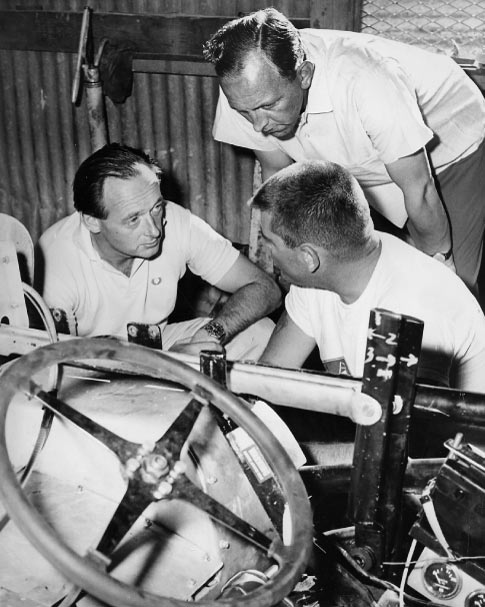
Campbell (left )in discussion with Mickey Thompson (right). Thompson played on Campbell's surreptitious nature.

Campbell (left )in discussion with Mickey Thompson (right). Thompson played on Campbell’s surreptitious nature.

Campbell initially made some gentle runs to get accustomed to the monstrous blue car, building up slowly from 200kph (124mph) to 386kph (240mph) before asking for the steering ratio to be lowered after the runs.

Despite still being unhappy with the steering, Campbell went back out to make his fifth run.  Bluebird managed to accelerate to 483kph (300mph) within three miles, putting a smile of relief on Campbell’s face. CN7’s designer, Ken Norris, promptly reminded him that the minimum required was two miles if they were to achieve a new record.   Campbell then made what would be a fateful decision to do some acceleration tests. Norris was clearly unhappy about this and Dunlop tyres Don Badger also reminded Campbell that the test tyres fitted to CN7 were only good for 483kph (300mph).

On the return run Campbell accelerated the massively powerful car much harder and had reached almost 580kph (360mph), when, in circumstances almost identical to Athol Graham’s accident, Bluebird strayed progressively off course before spinning sideways and rolling over.  The massive 4,354kg (9,600lb) car suddenly leapt into the air for what seemed like an eternity before crashing back down onto the salt as it continued to roll over, shedding wheels and bodywork until finally sliding on its belly to a halt.
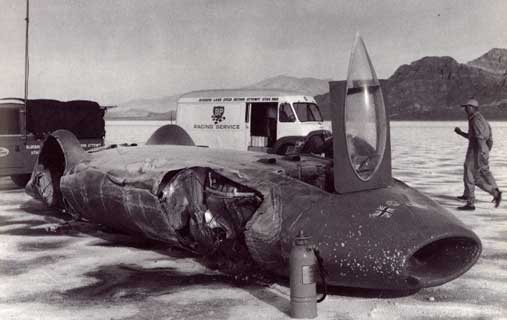
Campbell somehow survived the worlds fastest automobile accident.

Campbell somehow survived the worlds fastest automobile accident.

Although sustaining a fractured skull, contusion of the brain, a burst inner ear and various lacerations, Campbell had somehow survived the world’s fastest automobile accident.  But the car was a total write-off except for the Proteus gas-turbine engine and some minor ancillary components.

Bonneville Salt Flats and Cobb’s record had not been conquered. But this was to be just a prelude to a new chapter, as Campbell and a rebuilt Bluebird would challenge for the record again in Australia, while Arfons, Ostich and Thompson would try their hand once more at Bonneville.  For as different as these men were, they all shared the same dream and possessed the same kind of superhuman courage and determination that is needed to try and become the fastest man on land.

Words Geoff Dawes (C) 2002.  Images courtesy http://www.samuelhawley.com, http://www.gregwapling.com, http://www.thompsonlsr.com, http://www.dburnett.photoshelter.com, and http://www.rbracing-rsr.com.
Ewald Kluge, DKW and the Lobethal TT

In August 2013 that most famous of road racing circuits, the Isle of Man, celebrated its first Classic TT as part of the Festival of Motorcycling. With a burgeoning number of classic events around Europe, it was perhaps a long time coming to this historic racing venue. The event featured racing machinery from the 1950’s to the 1990’s, but perhaps more interesting was the presence of a pre World War Two German DKW SS 250 supercharged two-stroke, that was ridden on a parade lap by former 250cc Grand Prix winner Ralph Waldmann.

Two time European Champion Elwad Kluge.

Two time European Champion Ewald Kluge.

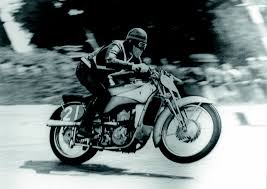
Brought to the Island by Audi Heritage to celebrate its historic victory in 1938, it was a recreation of the machine that Ewald Kluge used to become the first German, and only the second foreigner, to win a TT.  DKW was the largest manufacturer of motorcycles in the world during the 1930’s with a vast research and development department that boasted 150 employees.  DKW also produced cars and in 1932 merged with three other German car manufacturers Audi, Horch and Wanderer to become part of Auto Union, which was represented by the four linked circle insignia that the Audi brand still uses today.

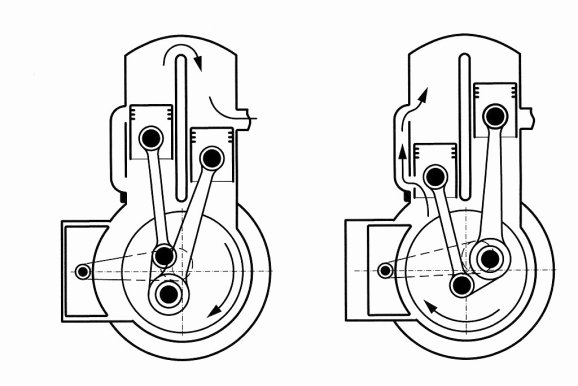
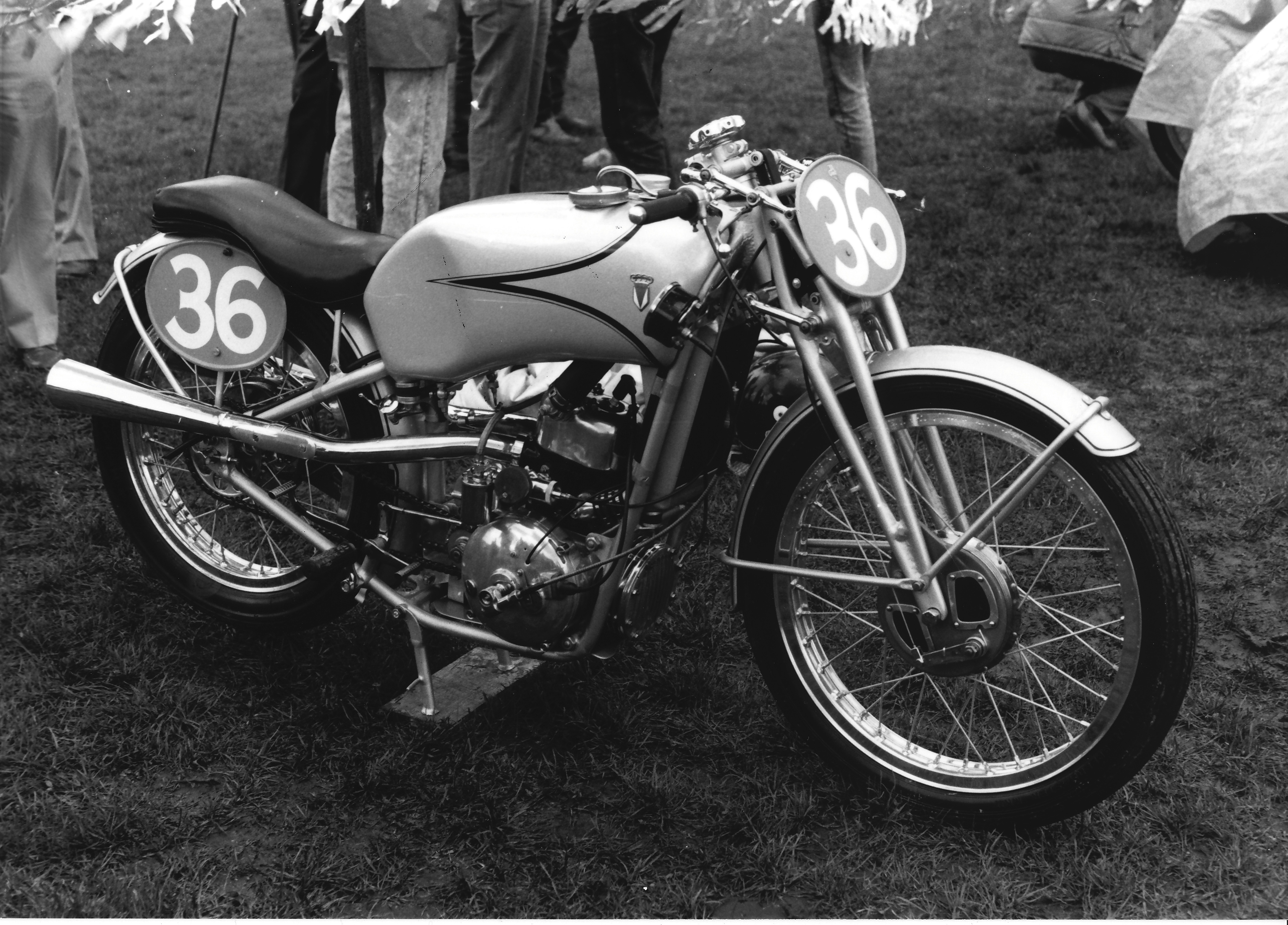
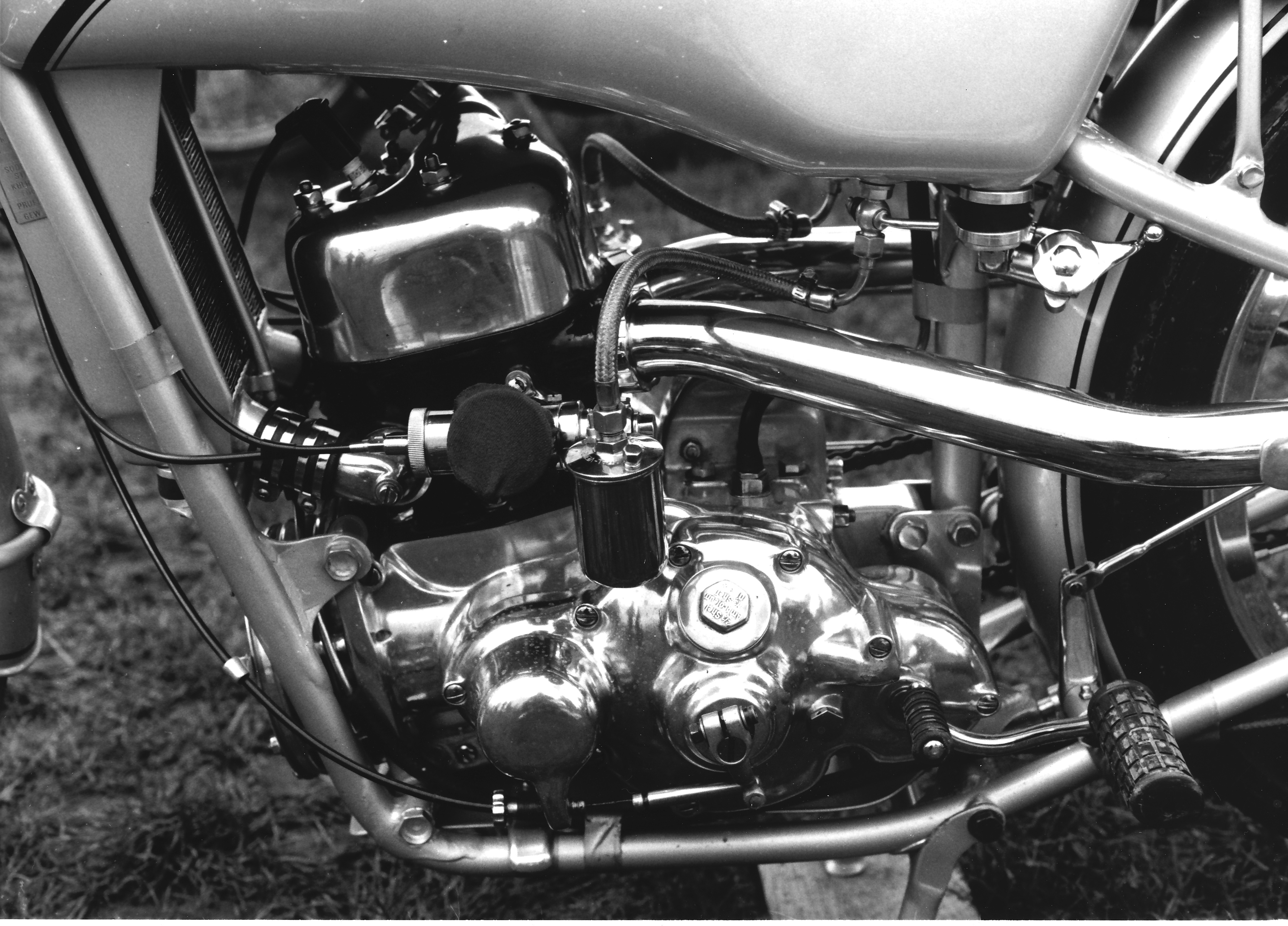
DKW’s only produced two-stroke motorcycles at that time, and in the 1930’s the technology was still in its infancy. But thanks to the innovative genius of Ing Zoller, DKW came up with a unique design that used a split single layout with tandem piston bores that utilised a common combustion chamber and articulated connecting rods. A third piston was housed in a pumping chamber or ladepumpe (supercharger) mounted horizontally to the front of the engine crankcases.  This forced the air and fuel from the Amal TT carburettors, which was inducted via a rotary valve, to be pressurised in the main crankcases. The end result was a big jump in power and also fuel consumption. With the megaphone style exhaust fitted it also had a reputation as one of the loudest racers of its era.

Engine diagram of the DKW SS 250 two-stroke engine.

Engine diagram of the DKW SS 250 ladepumpe (supercharged) two-stroke engine.

There is no doubt about the Nazi influence on the German Automotive industry before the Second World War.  Hitler bankrolled the racing efforts of the Silver Arrows, supporting Mercedes and Auto Unions dominance of Grand Prix motor racing.  It was all part of Hitler’s plan to show the world the technological superiority of Nazi Germany. The Nazi’s had infiltrated most aspects of German life and in 1932 set up the N.S.K.K. or the Nationalist Socialist Drivers Corps which “Nazified” the driving associations and clubs. It made it almost impossible for the national racing heroes of the era not to be associated with the Nazi’s.

Ewald Kluge was a member of the N.S.K.K. and became the Lightweight (250cc) European Champion in both 1938 and 1939 (which was the forerunner of the Moto2 world championship). From 1936 to 1939 Kluge was also a four-time German National Champion. But 1938 was his most successful year taking the European crown and the German road racing and Hillclimb titles. Out of fourteen events he entered, he won 12 and was second twice attaining the “Champion of Champions “ accolade that was only granted to those who achieved the highest possible number of points.

Kluge in action at the Isle of Man Lightweight TT.

Kluge in action at the Isle of Man Lightweight TT.

But Europe was not the only place that Kluge and DKW were to compete.   In 1937 the sleepy Adelaide Hills town of Lobethal in South Australia hosted the inaugural South Australian TT on a road circuit that compared favourably with those in Europe.  Enticed by the Lobethal Carnival Committee the DKW team was to tour Australia taking in events in other States as well. Officially it was called a cultural and sporting exchange. It may also have helped that there was a strong German influence in the area with immigrants settling in Lobethal and nearby Handorf in the mid-1800’s.

The circuit itself was on sealed public roads and eight and three-quarter miles in length (14.082 km) running in a clockwise direction and took in the towns of both Lobethal and Charleston. It was almost triangular in shape and featured hairpins, s-bends, fast sweepers and flat out straights with changes in elevation that ranked it as one of the best road courses of the time anywhere in the world.

Les Friedrichs is re-united with the works DKW in 1988.

Les Friedrichs is re-united with the works DKW in 1988 at the  Lobethal  TT recreation.

Baron Claus Von Oertzen managed the DKW team and his vivacious wife Baroness Irene Von Oertzen also accompanied him to Australia.  It was quite a shock to the locals when the teams van, plastered in swastikas, arrived in the township.  There were also rumours that a British Special Intelligence Service agent was shadowing the team as pre-war tensions began to rise.

The Baron had chosen a local rider, Les Friedrichs, to be Kluge’s co-rider and although this would be Friedrichs first road race he had outstanding credentials in other motorcycle sports. The choice was a good one and in the Lightweight (250cc) TT, Friedrichs followed home his team leader Kluge for a stunning 1-2 victory.  Kluge then went on to win the Junior TT (350cc) with his 250cc machine; such was the technical advantage of the German racer.

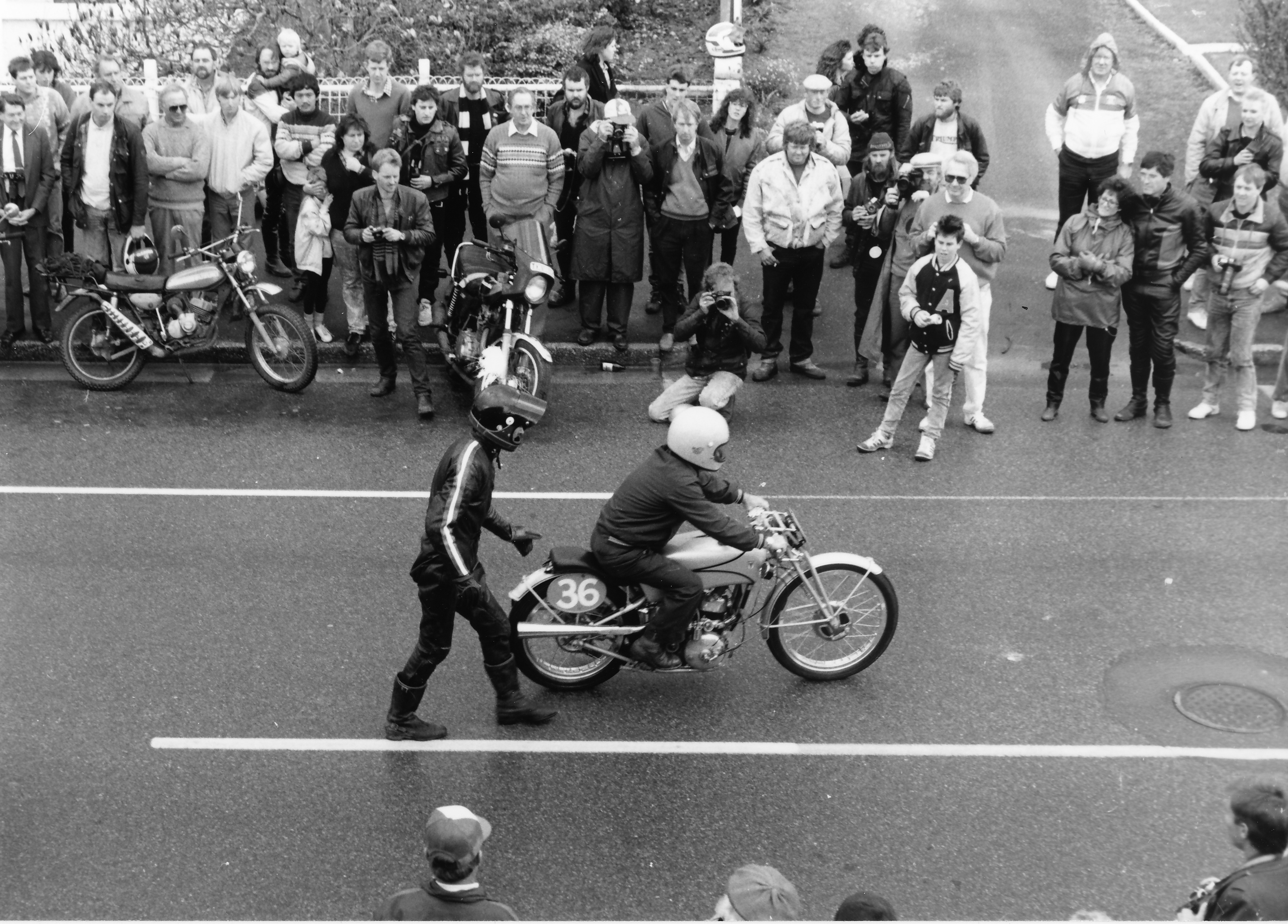
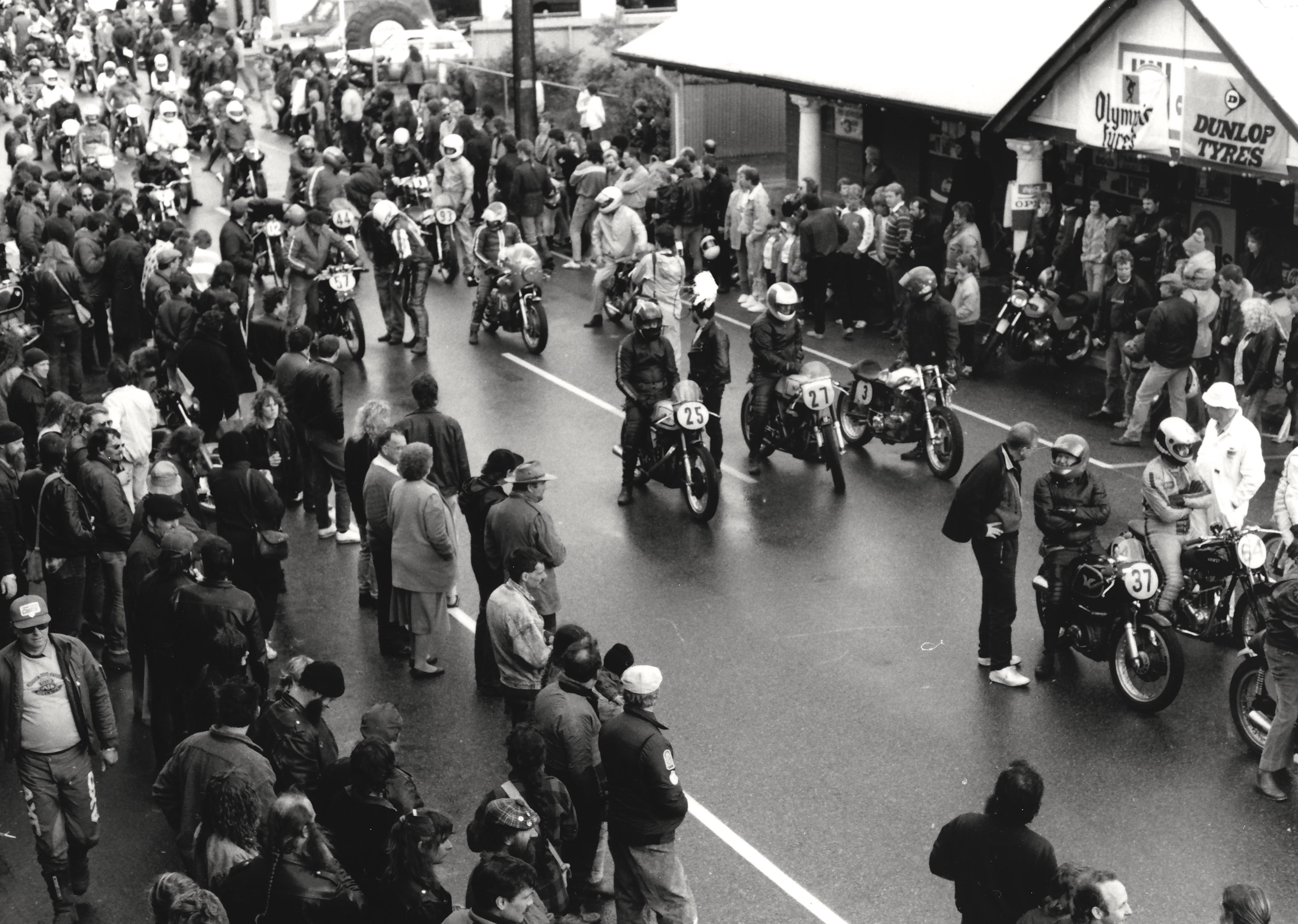
The grid lines up for the start of the 1988 Lobethal TT recreation.

The grid lines up in the main street of Lobethal for the start of the 1988 TT recreation.

Because of the success of the races, the following year the Auto Cycle Council of Australia endorsed the Lobethal event to be run as the Australian TT.  Racing car events were also held on the circuit, and the popular road course hosted the Australian Grand Prix in 1939. The Lobethal TT was held on the December Boxing Day holiday and the DKW team, as part of their tour, contested several interstate events in early 1938.

The team had planned to return again at the end 1938 and Kluge left behind his practice bike. This was a 1936 model works URe 250, which was left in the care of the Victorian DKW importer who was waiting for the arrival of a 1938 SS 250 production version of the factory machines. DKW was the first manufacturer to sell a production version of their “works” racers to the public.  However, the team did not return due to the onset of the Second World War.

Kluge was called up for military service in 1940 and was captured by the Russians and not released until 1949 due to his association with the Nazi’s.  At the age of 44, he returned to competition but suffered a severe high-speed accident at the 1953 Eifelrennen at the Nurburgring, which ended his career.  Ewald Kluge was only 55 years old when he passed away in 1964, leaving a remarkable racing legacy.

The 1936 works racer left behind by Kluge in 1938.

The 1936 works racer left behind by Kluge in 1938.

After the war road races were held at nearby Woodside and in 1948 racing returned once more to Lobethatl until the South Australian State Government banned racing on public roads and brought to an end any thoughts of resurrecting the Lobethal TT.

The ex Kluge machine was discovered again by Eric Williams in 1960 who retrieved it from the side of a house in St. Peters in Adelaide where it was found lying and slowly rusting away. The engine had blown up in a big way at the Sellicks Beach races.

Williams then spent 17 years restoring the machine, and it made an appearance in 1988 at TT88, which recreated the Lobethal TT as part of South Australia’s sesquicentennial. The TT reunited the DKW racer with a 78-year-old Les Friedrichs who performed a parade lap of the circuit stunning the onlookers with a cacophony of ear-shattering sound emitted by the exotic little racer.

Jewel like high tech two-stroke engineering in 1936 from DKW.

Jewel-like high tech two-stroke engineering in 1936 from DKW.

Williams sold the DKW in 1992 for $50,000 (Aus), a record for a vintage machine in Australia. Steve Hazelton outbid the American Barber Museum to keep the rare works racer in Australia, but 20 years later decided to put the DKW up for sale again.  Hazelton was extremely disappointed to receive very little interest from within Australia for this exotic ex-works racer.

It would no doubt be reassuring to Kluge, that Audi Tradition continues to honour his racing achievements and that of the DKW works team.  And although the roads around Lobethal are no longer used as a racing circuit, motorcyclists from all over Adelaide ride the course regularly to enjoy what was once one of the worlds great road racing circuits.

Words Geoff Dawes © 2014. Photographs Geoff Dawes (C) 1988. Images courtesy of http://www.audimediaservices.com. Diagram www.motorradonline.de.
Below is a link to a map of the Lobethal TT course. https://maps.google.com/maps/ms?msa=0&msid=201984503616328999196.0004d09b2905e2b5ca5e4

Who The Hell Is Steve Baker?

When American Kenny Roberts invaded the European Grands Prix in 1978, the two times  AMA Grand National Champion, left an indelible mark on the World Championship.  Not only did Roberts become the first American to win a 500cc world title  (the first of three), he also brought to Europe an American dirt track style of racing that would change the face of the sport forever.   Not only that, but Roberts was also instrumental in improving paddock conditions, safety and appearance money after ruffling the FIM and establishment’s feathers by proposing a breakaway “World Series” to compete with the Grands Prix.

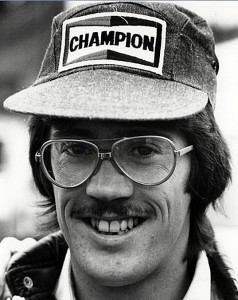
The quiet achiever Steve Baker.

The quiet achiever Steve Baker.

It’s therefore somewhat understandable that when the question of who was the first American to win a 500cc Grand Prix, it’s assumed it was Kenny.

In fact, it was a fellow Californian, Pat Hennen. Hennen started racing in the 500cc World Championship in 1976 for Suzuki GB and won his and America’s first 500cc Grand Prix in Finland that year. He also finished a creditable third in the Championship.  Hennen performed the same feat the following year, this time winning British Grand Prix and placing third again in the Championship. In 1978 Hennen won in Spain but suffered a severe race crash at the Isle of Man TT, which ended his career.

So who was the first American to win an FIM road racing World Championship? Ditto, again it’s assumed to be Roberts.

It was, however, a diminutive, unassuming, and quietly spoken character by the name of Steve Baker. Born on the 5th of September 1952 in Bellingham, Washington State, Baker, like so many of the American World Champions that followed, started out a dirt tracker.   At age 11 he would spend hours riding the many dirt trails around his hometown and at 16 began to race on short track and the TT dirt tracks of the Pacific Northwest. By the early 1970’s Steve had become one of the top-ranked novices, and junior TT riders in America.  Baker was by now racing in events up and down the west coast of the United States and Canada.

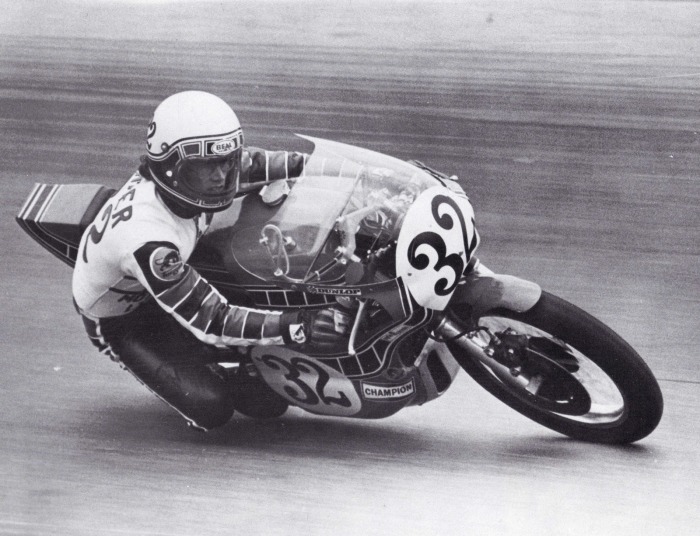
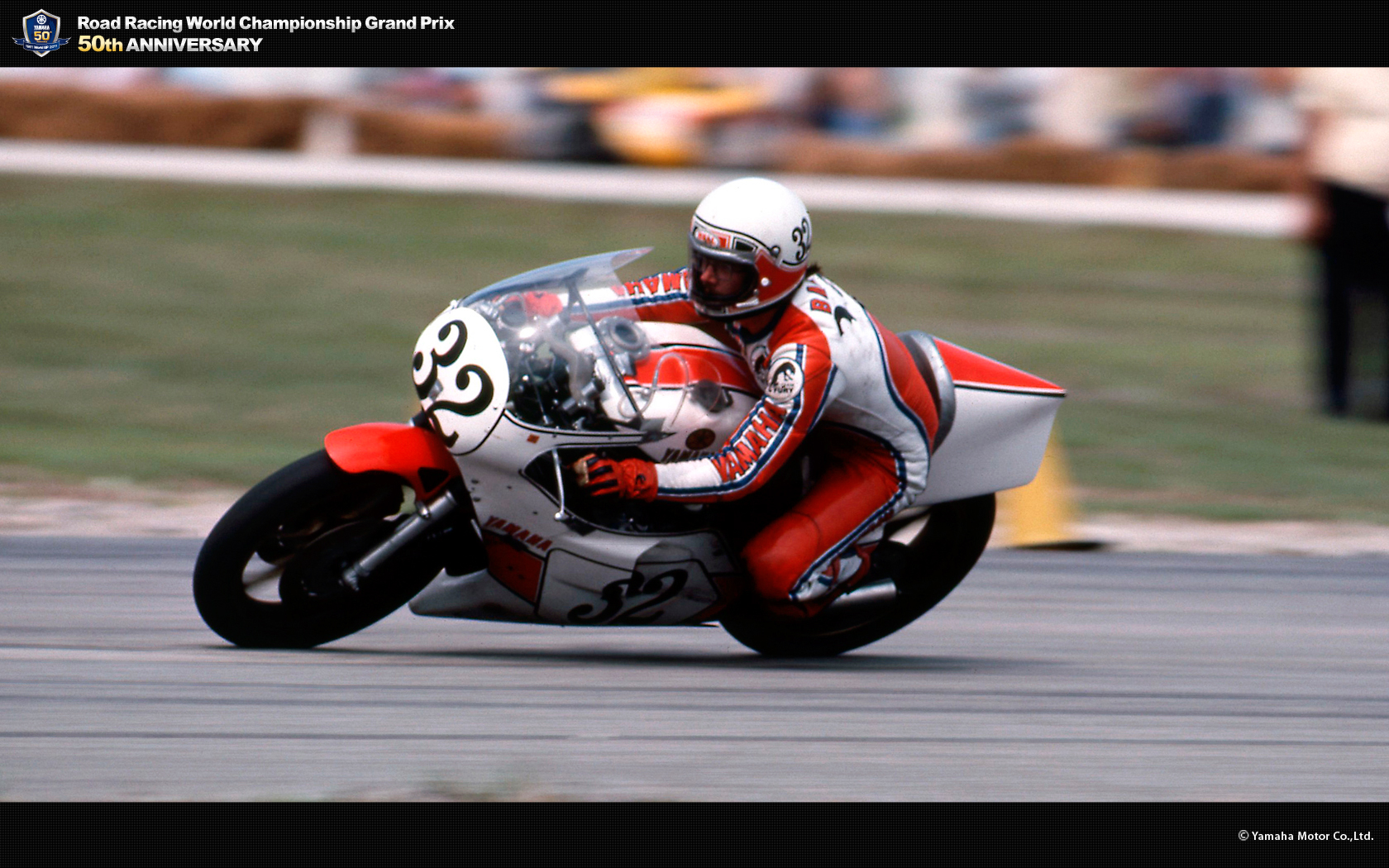
Baker at work on Yamaha Canada TZ750.

Baker at work on Yamaha Canada TZ750.

Steve then turned his hand to road racing, mainly in Canada, competing in as many as five classes during a typical weekend. It wasn’t long before Baker had a hat-trick of Canadian road racing titles to his name in the 500cc expert class, taking the number one plate in 1974, 1975 and 1976.  1976 was a good year for Baker who also took out the 250cc and unlimited expert class as well.

Baker had begun racing professionally in 1973 with sponsorship from Yamaha Canada’s Trevor Deeley, with Bob Work as his tuner. Baker’s debut in his first AMA national was at the 1973 Daytona 200 in which he finished 28th.  It was not until September that year that Baker showed his true potential with a creditable 2nd place to former 250cc World Champion Kel Carruthers at Talladega in Alabama.  Unfortunately, it was on the same circuit the following year that Baker crashed and broke his leg, leaving him sidelined for the rest of the year.

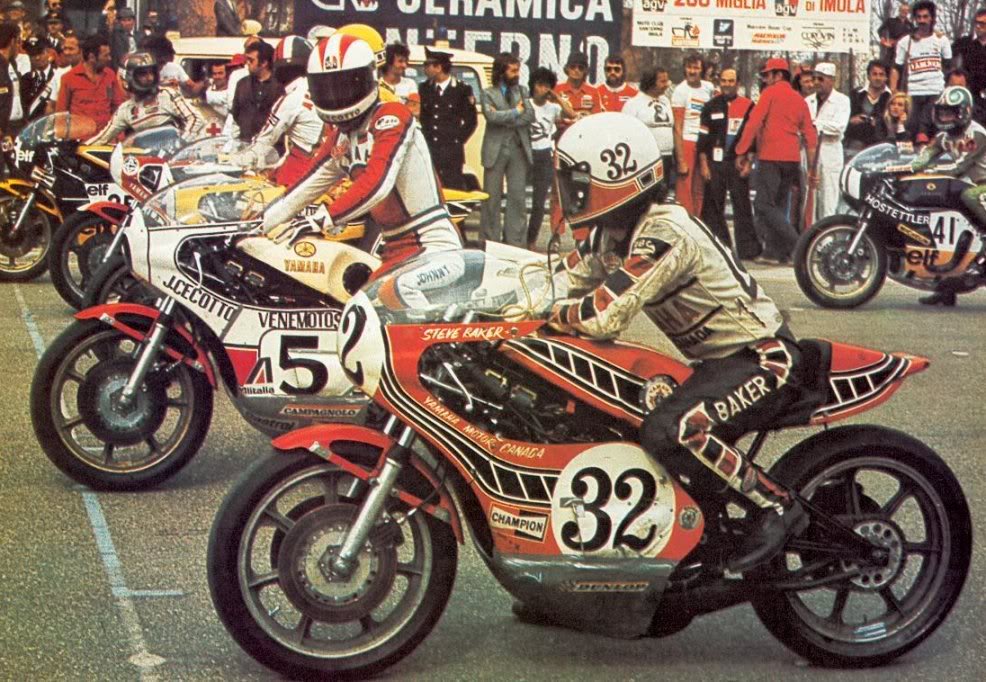
Bakers comeback ride was at Daytona in 1975, and it netted him a commendable 2nd place to Gene Romero. But it was in 1976 that Baker’s star really shone.  Now one of only five riders to receive a “works” OW31 TZ750 Yamaha, it proved to be an awe-inspiring combination.  Baker qualified 2nd to Kenny Roberts at the season-opening Daytona 200, but during the race suffered mechanical problems after holding down third place.  Disappointment turned to success at the next two FIM Formula 750 Prize events in Venezuela and at Imola in Italy with Baker winning both of the 200-mile races.

Baker on the grid alongside future factory teammate Johnny Ceccotto.

Baker on the grid at Imola alongside future factory teammate Johnny Cecotto.

On the home front, he recorded his first AMA national victory at the Loudon Classic in June and backed it up with a win in the 250cc race.  Baker repeated this at Laguna Seca again winning both the national and 250cc event.  1976 was also Baker’s debut in the Trans-Atlantic Match Races, a series that pitted a team of America’s best riders against seasoned English racers on circuits in the UK. Baker won four of the six races finishing second and fourth in the other two and was top points scorer of the series.  This was against riders of the calibre of Kenny Roberts, Barry Sheene and former world champion Phil Read.  Baker followed this up later that year with a win in the prestigious Race of the Year at Mallory Park beating the likes of 500cc World Champion Barry Sheene and multiple World Champion Giacomo Agostini amongst others.

For 1977 the FIM Formula 750 Prize had been granted full World Championship status with the season starting Daytona 200 as the opening round.  Baker by now had been drafted into the official Yamaha factory squad to contest not only the new 750cc World Championship but the 500cc World Championship as well alongside Johnny Ceccotto. Giacomo Agostini was also provided with “works” machinery through the Italian Yamaha importer.

Baker leads Roberts both on the OW31.

Baker leads Roberts both on the OW31.

Finally, everything seemed to come together for Baker at Daytona, qualifying on pole position and winning the race.  Baker also clinched the double by winning the International Lightweight 250cc race. The F750 World Championship consisted of eleven rounds most of which (unlike the Grands Prix) consisted of two heats. Six of the circuits Baker had raced on before and with the mighty OW31 at his disposal he was able to win five of the rounds, coming second in three and third in two. Baker never finished off the podium in the 10 championship rounds he contested. His nearest rival Frenchman Christian Sarron was 76 points behind.  America, at last, had its first FIM road racing World Champion.

BakerSteve2_l

Diminutive Baker manhandles the OW31 through the infield.

But it was the 500cc World Championship that Yamaha was most eager to capture.  The Japanese company had first entered the blue riband 500cc class in 1973 with 1972 250cc World Champion Jarno Saarinen.  Unfortunately, Saarinen was killed in the 250cc race at Monza while leading the point’s table in the 500cc class. Yamaha withdrew for the rest of the season but returned in 1974 with the great Giacomo Agostini.  Agostini went on to win the title for Yamaha in 1975 giving them and Japan their first 500cc World Championship. But in 1976 rival Japanese manufacturer Suzuki with the talented Barry Sheene had taken the title away. Yamaha was required to save face.

In 1977 the 500cc GP’s were also contested over eleven rounds, but many of the circuits were new to Baker. Steve was reported to have said in a recent interview that he was “overwhelmed by Europe” when contesting the championship.  Not only were their new circuits to learn, but there was also the question of racing in the rain, something that did not occur in the United States.  On top of that, there was the culture shock of living outside of the states. Then, of course, there were the street circuits, which were part of the Grand Prix calendar.  Spa in Belgium, Imatra in Finland, Brno in Czechoslovakia and Opitijia in Yugoslavia all could prove deadly and finding the right place to make up time or take calculated risks could only come from experience. Let’s not forget that 1977 saw the British Grand Prix on the mainland for the first time (at Silverstone) after the top riders of the day vetoed that most deadly of all road courses, the Isle of Man TT.  Even the closed circuits at that time could not be considered “safe” by today’s standards, and fatalities regularly took place.

It was with this backdrop that Baker contested the championship, taking on seasoned campaigners like World Champion Sheene and a flotilla of “works” or factory-supported RG500 Suzuki’s, not to mention his own teammate Ceccotto and Agostini on the other factory Yamaha YZR500 0W35’s.

At the end of a tough season, Baker finished in a creditable second place to World Champion Barry Sheene.  He had scored second place three times, third place three times, fourth once and fifth once.  The second round of the 500cc Championship had been boycotted in Austria at the Salzburgring after an accident in the 350cc race that saw one rider killed and several others seriously injured, including Baker’s teammate Johnny Ceccoto, who broke his arm. At the other two tracks that made up the series in Finland and Czechoslovakia, Baker suffered mechanical problems which blunted his final points tally,  80 to Sheene’s 107.
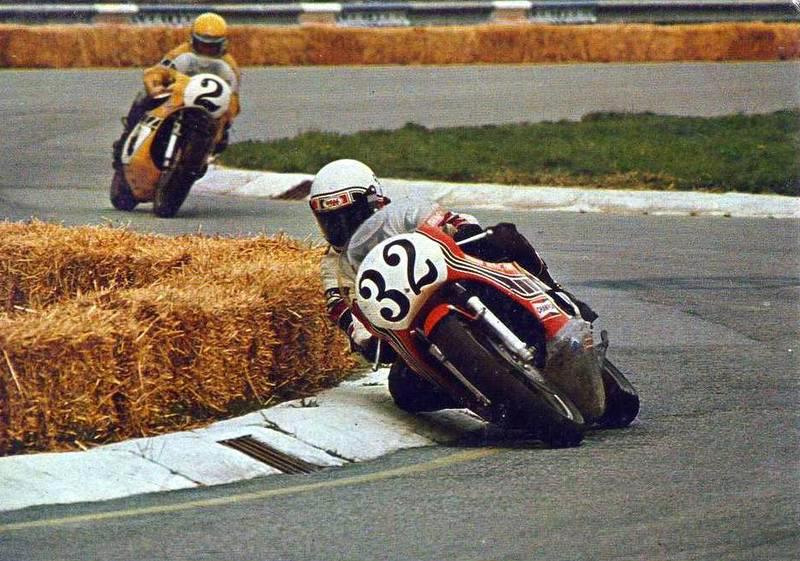
Always fast.

Always fast.

With such a performance in his rookie year, a factory contract for 1978 might have been expected.  The only thing that Baker hadn’t achieved was winning a 500cc Grand Prix.  Unfortunately Yamaha top brass witnessed a domestic bust-up between Baker and his fiancé Bonnie with his sister and Bob Work at the Dutch TT in Assen.  This seemed to seal Steve’s fate, and a contract was not forthcoming.

The Gallina team signed Baker for the following season on a private Suzuki RG500. But against factory machinery, he could only achieve seventh in the championship, his best result a third-place podium in Venezuela.  Baker also competed in the F750 World Championship for the Gallina team on a production Yamaha TZ750E although he was “allowed” to ride Yamaha Canada’s factory OW31 in North America.  Daytona was no longer part of the F750 World Championship in 1978, although it was still the most significant road race in America. Baker suffered a DNF through mechanical failure while in second place chasing Kenny Roberts. The season turned out to be one of mechanical failures and risky strategy for Baker, desperate to try and compete with the “works” machines. To cap off a disastrous season, at the last round at Mosport in Canada, Baker was involved in another riders fatal practice crash. Baker escaped with a badly broken arm and leg.

Steve finished sixth in the Championship with his best results being two-second places at Imola and Laguna Seca and a third-place at Paul Ricard. The following season, in 1979, Baker was set to race in the MCN/Superbike championship in the UK riding a Yamaha TZ750F for Sid Griffiths.  At the second round of the series, at Brands Hatch, Baker crashed entering Paddock Hill bend and sustained similar injuries to his Mosport crash of the previous year.

Bakers privateer Gallina TZ750D.

Bakers privateer Gallina TZ750E.

Steve Baker left the sport without having the chance to fulfil his enormous potential and returned home to open a Yamaha dealership in his hometown of Bellingham, which he runs to this day. Often overlooked as America’s first World Champion, Baker holds no grudges, and there is no bitterness, only humble gratitude to have been able to enjoy the experience.

In recent years Baker has ridden for the Yamaha Classic Racing Team at numerous classic events around Europe, jogging peoples memories while attracting new fans, and reminding us all of the very special the talent that is, Steve Baker.

Words Geoff Dawes © 2014. Images courtesy http://www.global.yamaha-motor.com, http://www.aircooledrdclub.com, http://www.classicmotorcycles.net and http://www.ge-board.de

Life Without Rossi

Rossi on his 2001 Championship winning NSR500 two-stroke.

It was not that long ago that the very thought of MotoGP without Valentino Rossi was almost heresy.  Although Rossi’s eventual retirement was an inevitable reality, there was some consternation about the future popularity of the sport and its existence as a saleable commodity without him.  Rossi’s ability to engage such a broad demographic of fans, from children to retirees has given Grand Prix motorcycle racing the kind of exposure that other forms of motorsport would dearly love to have had. His post-race antics, charm and humility, coupled with an amazing ability to push a Grand Prix racing motorcycle to the very limit, using racecraft so ruthless it enabled him to regularly outwit his many opponents is legendary.

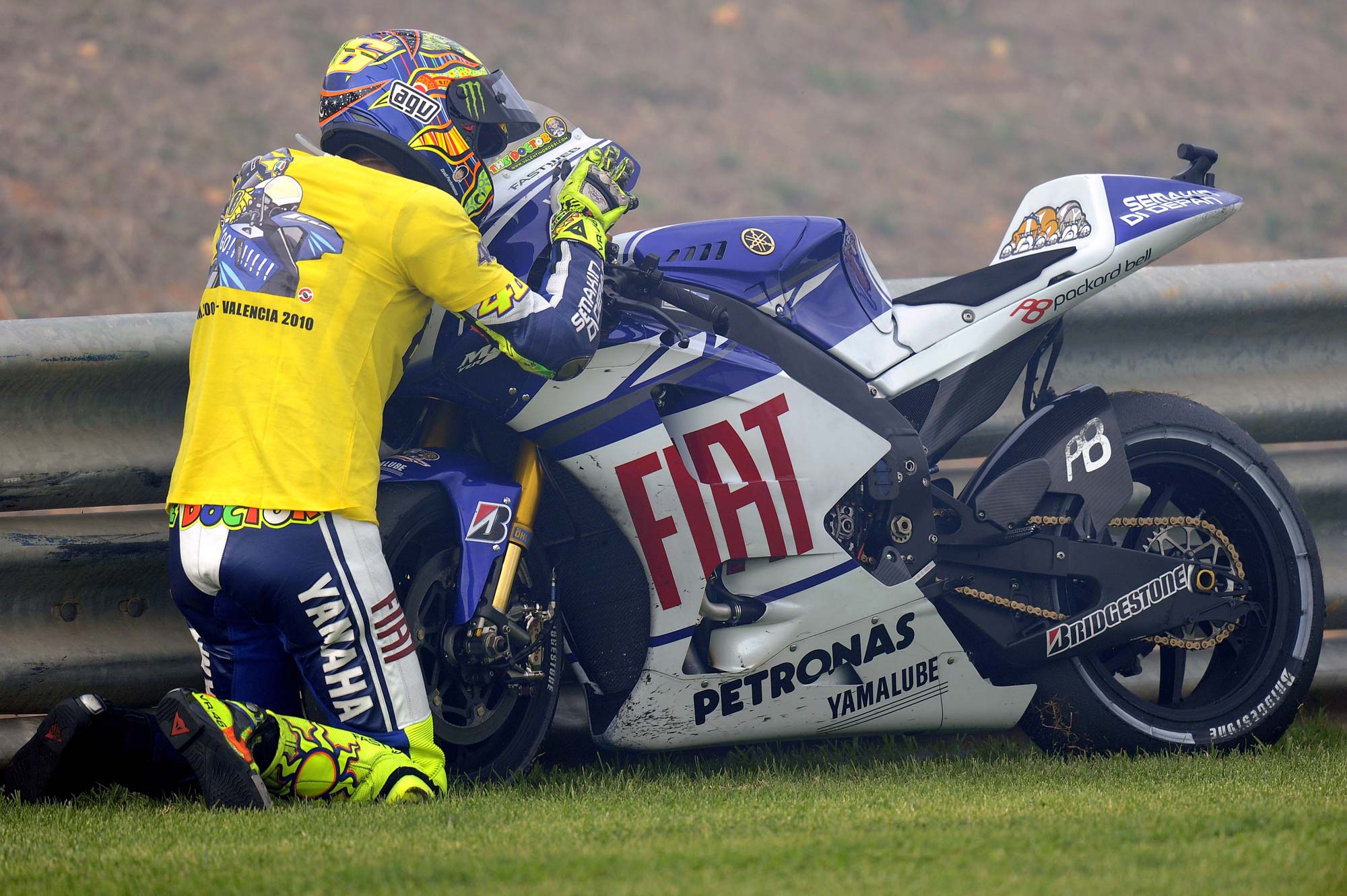
Rossi is arguably the greatest rider of all time, having won a record 80 MotoGP compared to the 68 of the great Giacomo Agostini.  But next month, on February 16th Valentino will celebrate his 35th birthday, and after three years with only one win, Rossi has given himself six races before he decides whether he will continue in MotoGP in 2015.  That sixth race will be his “home” Grand Prix at Mugello a race he has won a record seven times.

The surprise sacking of longtime crew chief, Jeremy Burgess, at the 2013 season-ending race in Valencia, sent shock waves through the paddock.  As Burgess pointed out at a pre-race press conference “I’ve read many sports biographies and quite often the top sportsman in the latter part of his career will have a change of caddy or a change of coach, and this is what we’re working on. We worked on fixing the problem for four years, and this is part of that fix, and this is the next step to try and get Valentino back on top.” But is there more to Valentino’s lack of form since his last championship in 2009?

Valentino on the 990cc RC211V Honda 5 cylinder four-stroke.

Valentino on the 990cc RC211V Honda 5 cylinder four-stroke.

Burgess has also mentioned the “survival gene” that kicks in when a rider reaches their thirties and can erode a competitor’s ability to push to the absolute limits on a Grand Prix motorcycle.  Micheal Scott, a longtime Grand Prix journalist and the editor of the authoritative annual Motocourse, had previously noted in his column, that during his long career Rossi had always possessed that bit of luck which saved him from serious injury when involved in a practice or race crash.  That was not the case however in 2010. Rossi suffered a pre-season Motocross accident that severely affected his right shoulder and was not rectified until after the season had finished. But more tellingly a practice crash at Mugello, a circuit that Rossi had so much success on, bit back, giving the Italian a broken leg and for the first a time in his career caused him to miss not just one race, but three. Was the magic waning?

Rossi after winning the 2010 Malaysian GP aboard his beloved 800cc four-stroke Yamaha YZR-M1.

Rossi after winning the 2010 Malaysian GP aboard his beloved 800cc four-stroke Yamaha YZR-M1.

Dealing with a recalcitrant Ducati in 2011 and 2012 did little to admonish the growing number of doubters that believed Rossi’s star was on the decline. Perhaps more tragically though was the effect that Valentino’s innocent involvement in Marco Simoncelli’s fatal accident in Malaysia may have had.  I for one cannot comprehend how difficult it must have been for Valentino to deal with.

The most reassuring thing about Rossi though is his love of racing and commitment to the sport. As the owner of a new Team Sky- VR46 Moto3 team, which he formed in a bid to help cultivate young Italian talent for the Grand Prix, there is no doubt that Rossi’s presence and star quality will thankfully be around the paddock for many years to come.

Words Geoff Dawes ©2013. Images http://www.sportrider.us, http://www.hdwallres.com and http://www.yamaharacing.com

Reminiscing: The Honda CB1100RC

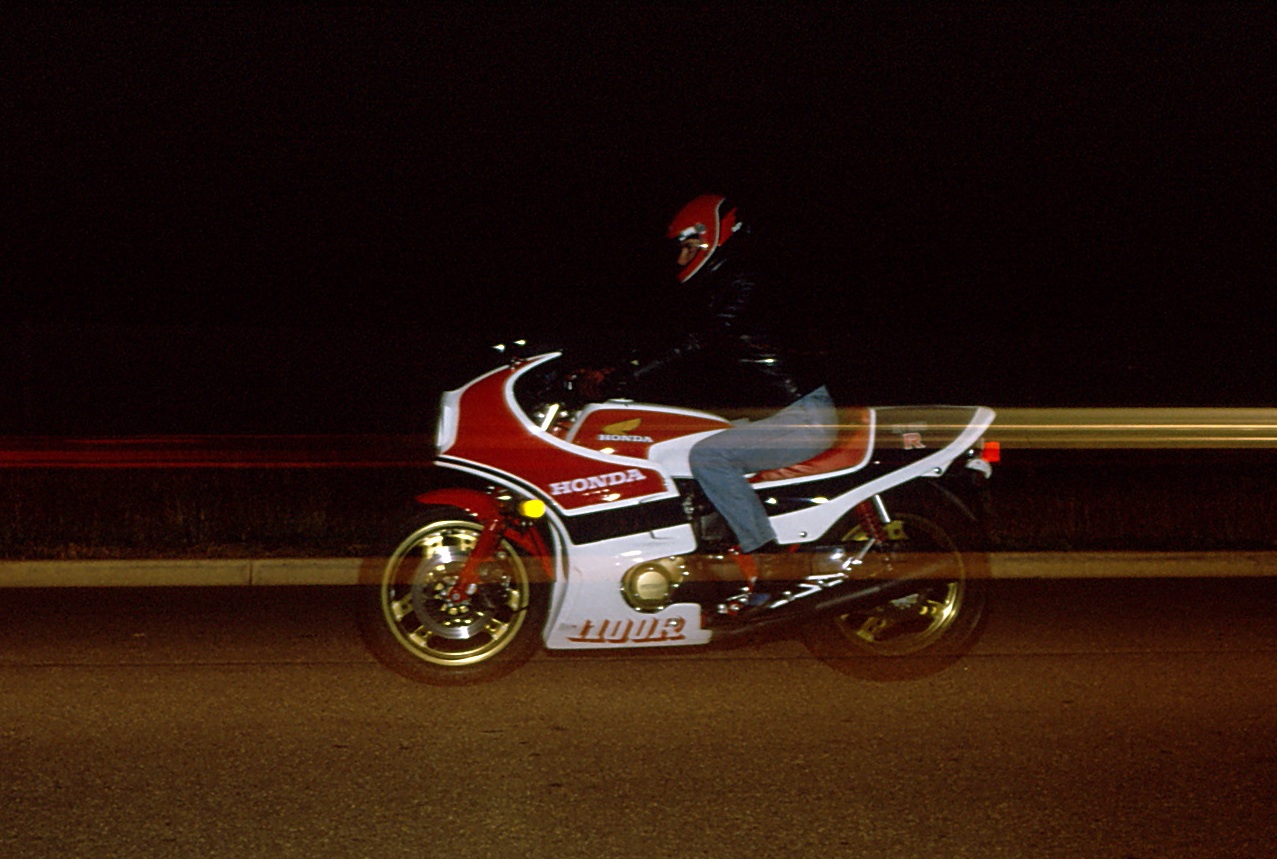
Not a small motorcycle but extremely functional.

In 1982 the there was only one thing better for a Japanese motorcycle enthusiast to see than a Honda CB1100RC and that was more than one. In fact, it was the sight of five of the limited run, homologation specials, that greeted me on the forecourt of Trevena Honda at their Main North road dealership.  Only 200 of the RC model had been imported into Australia, and I was on a mission to secure one for myself.

My current bike, at that time, was a 1979 Honda CB900FZ, the machine the RC was based on. It was in my opinion, a somewhat underrated motorcycle that boasted lightweight, good handling and attractive styling, yet it had been pushed into the background due to the capacity war being waged with the other Japanese manufacturers.

The CB1100RC though was a different kettle of fish. Built primarily to redress the balance of power in production bike racing, it was not cheap. At $5,800 (Aus) it was almost twice the price of the CB900FZ it was based on, although this was tempered somewhat by the fact, that as a limited run special, it would hold its price and potentially appreciate in value.

That first ride home on the RC was an interesting one as it was the first time I’d ridden a motorcycle with a full fairing.  It proved to be quite effective at keeping the wind and weather off the rider although the hands were less well protected.  The footpegs were set slightly higher and a bit more rearward pushing the rider’s knees into the alloy fuel tanks indentations. The adjustable handlebars (a similar system to Laverda’s) were in the dropped position giving a good “feel” from the front end.  The brakes were highly effective causing the forks to compress considerably.  The RC was physically a large machine, but it steered and changed direction with relative ease.

Once at home it was time to indulge in the motorcyclist’s favourite pastime, making adjustments to the bike.  The TRAC anti-dive system on the front forks was set at number one of its four positions, hence the accentuated nose-dive under brakes. This setting was changed to number three, and the air pressure in both forks was set to 25psi (between 23 to 27psi was recommended by Honda).

Air caps on the fork top and the engine oil temperature gauge with warning lights.

Air caps on the fork top and the engine oil temperature gauge with warning lights.

The remote reservoir gas charged FVQ rear shockers had four compression, three extension damping settings and five spring preload settings.  These were adjusted with the spring preload set to three, the compression damping to three and the rebound damping to two.  The eighteen-inch wheels fitted to the RC sported 2.5inch front and 3.0inch rim rear widths respectively.  Checking the standard fitment Japanese Dunlop F11 100/90 V18 and K527 130/80 V18 tyre pressures was another essential job.

Next was to set the handlebars in the “flat” position. This was easily done by loosening the hexagonal through bolt enough to disengage the meshed “teeth” of the lower and upper part of the handlebar, so the upper bars could be tilted into the flat position, and then re-tightened.

A quick run on a favourite stretch of road showed the suspension adjustments had firmed up the big Honda making it more responsive to rider input and the raised handlebars improved the comfort of the riding position.

The owner’s manual was also very comprehensive and more of a condensed workshop manual, showing tolerances and recommended replacement of engine parts in racing kilometres/miles. The regular service schedule for normal road use was fairly standard, and the manual also quoted the CB1100RC as giving 115hp at 9,000rpm and 75kg-m at 7500rpm some 20hp up on the CB900FZ.

All the usual service points on the RC were easily accessible for the home mechanic.  The fairing lower took about five minutes to remove to reach the oil filter and cam chain tensioner, while the fuel tank had to be removed to gain access to the spark plugs and carburettors. The air filter was also easily accessible through the air-box side cover.  The RC was not fitted with a main-stand, but a rear paddock type stand was available from Honda dealers.

Naked RC. It took about forty minutes to undress.

Naked RC. It took about forty minutes to undress.

It became apparent after running in the RC that this motorcycle could be used as a serious high-speed, long-distance sports tourer.  On a favourite piece of road riding the CB900FZ at 120kmh was a comfortable rate of knots, but on the RC this seemed slow, and 140kmh was a comparative trot.  The full fairing was doing its job with very little buffeting, even around the rider’s helmet.  The power delivery of the 1062cc engine was quite linear, with a flat torque curve making hard acceleration deceptive with only a slight jump in power at higher revs.

What did become apparent though was a vibration zone at around 4000-4500rpm that could be felt through the footpegs and handlebars, was more predominant through the large 26lt alloy fuel tank.  This did eventually cause an internal baffle in the tank to break away which sounded like a buzz saw at these revs.  Also, a baffle in the right-hand exhaust became loose and rattled.  Both of these problems were fixed without question under warranty.  The engine did smooth out considerably once out of this “zone”, although this did translate into higher illegal road speeds.

FVQ gas charged remote reservoir shock absorbers.

FVQ gas charged remote reservoir shock absorbers.

The only down sides that the RC did have was a restricted turning circle, thanks to the large fuel tank and fairing, but once this was factored in it never really became an issue. Also carrying a pillion passenger was really not a design prerequisite for the RC.  The pillion part of the seat was higher, and the bulk of the weight of the passenger was behind the rear axle line of the motorcycle.  This really didn’t help the handling of the RC regardless of the suspension settings.

Although the front brakes were Honda’s very effective new twin-piston floating calipers that gripped 300mm ventilated disks, I opted to have the optional braided steel brake lines fitted. These were standard on the U.K. model and gave better initial bite and feel and were a worthwhile investment.

The Honda’s presence on the road was also quite impressive.  This was the first motorcycle I can remember that had car drivers change lanes to get out of the way. Other drivers would slow down just to see what sort of exotic piece of kit it was. Indeed the prominent fairing and bright colour scheme made the motorcycle quite visible to other road users, and it made the rider feel that little bit safer in traffic.

What I didn’t expect was the reaction of other motorcyclists.  In one instance I was told that it was a racer for the road and impractical for everyday use, and there was no way you could use all the power available.  This was from a group of riders, one of whom rode a Laverda Jota!

A comfortable sports tourer.

A comfortable sports tourer.

In reality, the Honda CB1100RC was a motorcycle you could commute to work on and use for weekend blasts through the hills.  And for five years I did exactly that and enjoyed every minute of it. The RC’s engine performance was user-friendly, as was the superb handling in just about all conditions. It was a big and heavy bike, and after few hours of scratching on winding roads, the rider would know it. But this just added to the satisfaction of riding this type of motorcycle.  The Honda was also a competent sports tourer that with the handlebars in the “flat” position was quite comfortable over long distances.

Many of the specifications of the CB1100RC were carried over to the CB1100F with improvements (including rubber mounting the engine) that made it more civilised than its production-racing cousin.  Unfortunately, the CB1100R series and CB1100F were also the last generations of big air-cooled four-cylinder bikes from Honda that along with other Japanese models quickly became dinosaurs in the fast-moving technological evolution of the performance motorcycle.

Words Geoff Dawes (C) 2014. Photographs Geoff and Vivienne Dawes © 1982.